How Improperly Sized Systems Shorten Equipment Life
Delta T Heating & Cooling
Why wrong-sized HVAC systems die young and how to prevent it — learn how improperly sized systems shorten equipment life.
Why Wrong-Sized HVAC Systems Fail Years Too Soon
Understanding how improperly sized systems shorten equipment life could save you from replacing your HVAC unit years ahead of schedule. Here is the short answer:
How improper HVAC sizing shortens equipment life:
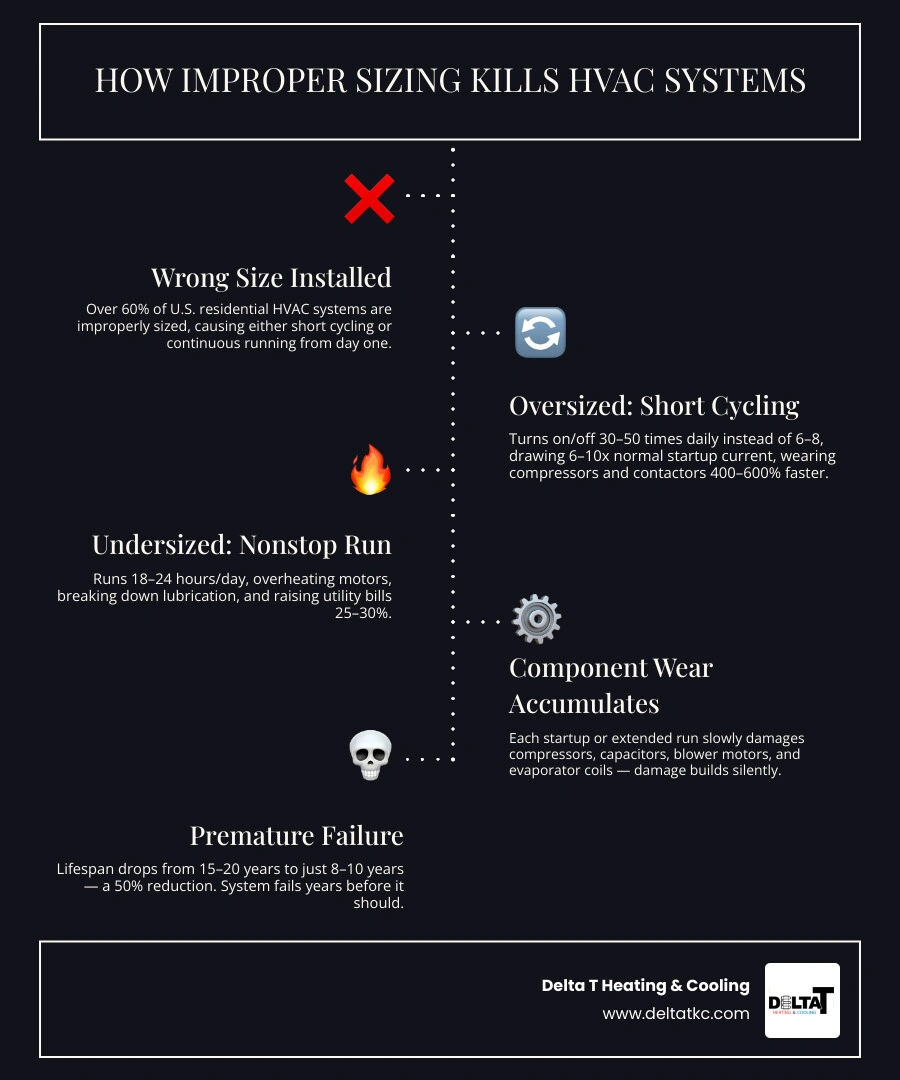
- Oversized systems short-cycle — turning on and off 30 to 50 times per day instead of a normal 6 to 8. Each startup draws 6 to 10 times the normal electrical current, wearing out compressors, contactors, and capacitors 400% to 600% faster than normal.
- Undersized systems run almost continuously — up to 18 to 24 hours a day — overheating motors, breaking down lubrication, and pushing utility bills 25% to 30% higher.
- The result: Both problems cut a system's expected lifespan from 15 to 20 years down to just 8 to 10 years — a reduction of up to 50%.
Over 60% of residential HVAC systems in the United States are the wrong size. Most homeowners have no idea until something breaks. The damage does not show up on day one. It builds quietly, startup by startup, until a compressor seizes or a blower motor burns out — often years before it should.
I'm Adam Golubski, and in this guide I'll walk you through exactly what goes wrong inside an improperly sized system and what you can do to protect your investment.
What Does "Improperly Sized" Mean in HVAC Design?
When we talk about an "improperly sized" HVAC system, we aren't talking about the physical footprint of the metal cabinet sitting in your basement or next to your patio. Instead, we are talking about the system's thermal capacity—its ability to add or remove heat from your home.
This capacity is measured in two main industry terms:
- BTUs (British Thermal Units): A BTU is the amount of heat required to raise the temperature of one pound of water by one degree Fahrenheit.
- Tonnage: In residential cooling, capacity is often described in "tons." One ton of air conditioning equals 12,000 BTUs per hour. The term historically comes from the cooling power of a literal one-ton block of ice melting over a 24-hour period.
For decades, many builders and contractors relied on the "square footage myth" to size systems. You might hear someone say, "You need one ton of cooling for every 500 square feet." While that rule of thumb was convenient in 1980, it is a recipe for disaster today.
Modern homes in places like Overland Park and Olathe are built with much tighter building envelopes, advanced insulation, and high-performance windows. Conversely, older homes in historic neighborhoods might have drafty walls and minimal attic insulation. Two homes with the exact same square footage can require completely different HVAC capacities.
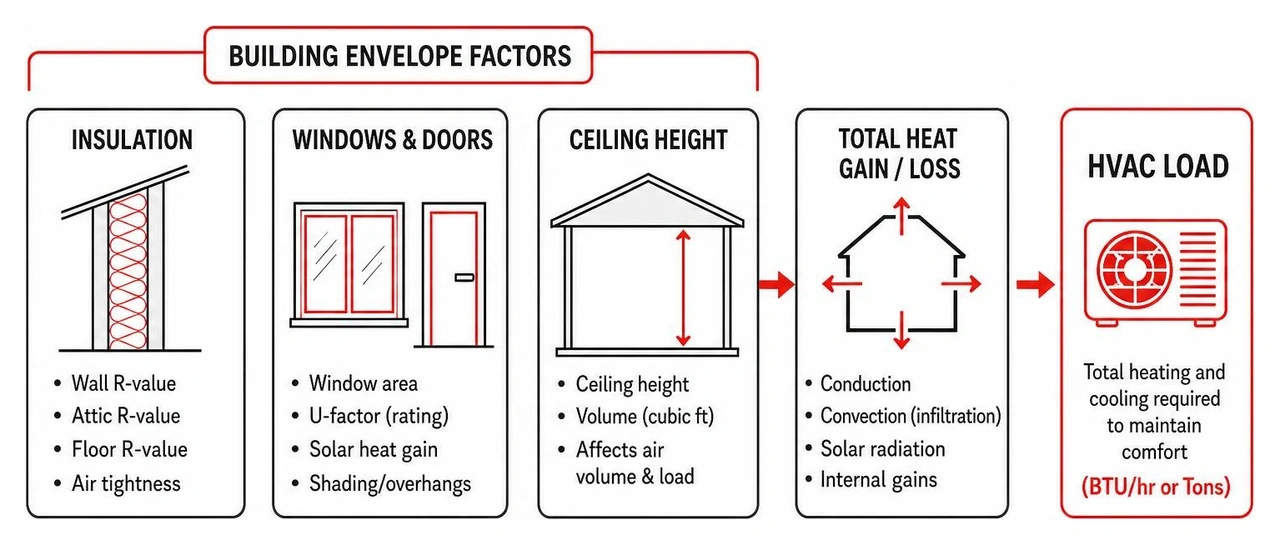
To get sizing right, professional HVAC designers use a Manual J load calculation, a protocol established by the Air Conditioning Contractors of America (ACCA). A Manual J calculation doesn't guess. It analyzes:
- The local climate and design temperatures for the Kansas City metro.
- The orientation of the house relative to the sun.
- The R-value of wall, floor, and ceiling insulation.
- The area, shading, and U-factor of all windows and doors.
- The heat generated by appliances and the occupants themselves.
Without this scientific calculation, a system is almost guaranteed to be mismatched.
How Improperly Sized Systems Shorten Equipment Life
An HVAC system is a major financial investment. When properly sized, installed, and maintained, a standard central air conditioner or heat pump should easily last 15 to 20 years, while a high-quality gas furnace can push past 20 years.
However, when a system is mismatched to the home's thermal load, that expected lifespan is cut nearly in half. Instead of enjoying two decades of worry-free comfort, homeowners with improperly sized systems often face catastrophic equipment failure between years 8 and 10.
To visualize the mechanical toll, let's compare how properly sized, oversized, and undersized systems operate under typical summer design conditions:
| Operating Metric | Properly Sized System | Oversized System ("The Sprinter") | Undersized System ("The Marathoner") |
|---|---|---|---|
| Cycles Per Day | 6 to 8 cycles | 30 to 50 cycles | 1 to 2 cycles |
| Cycle Duration | 15 to 20 minutes | 3 to 7 minutes | Hours to continuous running |
| Total Daily Runtime | 8 to 12 hours | 4 to 6 hours | 18 to 24 hours |
| Start-and-Stop Wear | Standard / minimal | Extremely high (400%–600% increase) | Low |
| Electrical & Thermal Stress | Balanced | Severe electrical spikes & thermal shock | Severe heat buildup in motor windings |
| Expected Lifespan | 15 to 20 years | 8 to 10 years | 8 to 10 years |
| Primary Failure Points | Natural wear over time | Compressors, contactors, capacitors, heat exchangers | Blower motors, seized compressors, frozen coils |
As you can see, both extremes lead to the same destination: premature equipment failure. The physical reasons why this happens are deeply rooted in mechanical and electrical engineering.
When a system is oversized, it behaves like a high-performance sports car stuck in heavy, stop-and-go city traffic. It blasts on, rapidly cools the air immediately around the thermostat, and shuts off before it can complete a proper cycle. This is known as short cycling.
Oversized vs. Undersized Systems: Different Problems, Same Premature Failure
While both oversized and undersized systems die young, they take completely different paths to get there. One suffers from rapid, explosive wear and tear due to constant starting and stopping, while the other slowly cooks itself to death through relentless, nonstop operation.
This divergence highlights the difference between sensible load (the heat you can feel on a thermometer) and latent load (the moisture suspended in the air).
A properly sized system is engineered to handle both. It runs long enough to lower the indoor temperature while simultaneously pulling humidity out of the air. When sizing is wrong, this balance is destroyed, creating massive thermal stress on internal components.
How improperly sized systems shorten equipment life through short cycling
Short cycling is the ultimate silent killer of air conditioners and heat pumps. When an oversized unit turns on, it floods the ductwork with cold air, satisfying the thermostat in a matter of minutes. But because the system shuts off so quickly, it inflicts severe mechanical and electrical damage:
1. Inrush Current and Electrical Burnout
Every time your air conditioner starts up, the compressor motor must overcome static friction to begin pumping refrigerant. This requires a massive surge of electricity called inrush current, which is typically 6 to 10 times higher than the system's normal running current.
This sudden electrical surge generates intense, rapid heat within the motor windings. When a system starts 30 to 50 times a day instead of 6 to 8, this heat bakes the winding insulation. Over time, the insulation cracks, leading to an electrical short and a burned-out compressor.
2. Lubrication Migration
The compressor is the heart of the refrigeration cycle, and it relies on specialized oil to keep its internal pistons and scrolls lubricated. This oil naturally mixes with the gaseous refrigerant and circulates through the outdoor coil, indoor coil, and back to the compressor.
However, it takes at least 10 to 12 minutes of continuous operation for the refrigerant to reach the proper pressure and velocity to carry this oil back home. In an oversized system that runs for only 5 minutes at a time, the oil gets stranded in the indoor evaporator coil. Starved of lubrication, the compressor runs dry, leading to internal metal-on-metal grinding, bearing failure, and eventual seizure.
3. Contactor Arcing and Capacitor Failure
Your system's electrical contactor acts as a heavy-duty switch that closes to send power to the compressor and outdoor fan. Every time the contactor closes and opens, a tiny electrical arc jumps across the silver-plated contacts.
Under normal cycling, these contactors last for years. But under the constant pounding of short cycling, the contacts pit, burn, and can weld themselves shut. Similarly, the run capacitor—which stabilizes the voltage to the motors—is subjected to constant voltage spikes, causing it to overheat and fail prematurely.
4. Formicary Corrosion
Because oversized systems short-cycle, the indoor evaporator coil never stays cold long enough to properly drain moisture. Instead, water vapor condenses on the coil and sits there when the system shuts off.
Household volatile organic compounds (VOCs) from cleaning products, paints, and building materials dissolve in this standing water, forming mild acids. These acids attack the copper tubing of the coil, causing microscopic pinhole leaks known as formicary corrosion.
How improperly sized systems shorten equipment life through nonstop operation
On the other end of the spectrum is the undersized system. An undersized unit is like a marathon runner forced to sprint at top speed for 24 hours straight without a single water break. During peak summer days in Fairway or Shawnee, an undersized system will run continuously without ever reaching your thermostat's setpoint.
This nonstop operation destroys components through sheer exhaustion:
1. Blower Motor Overheating
The indoor blower motor is designed to move air through your home's ductwork. While it is engineered for long runtimes, it relies on the air passing over it to help dissipate its own internal heat.
When a system runs continuously for 18 to 24 hours a day in a hot attic or closet, the heat buildup inside the motor windings eventually exceeds the motor's thermal limits. The internal safety switches trip, or the motor simply bakes itself until the bearings seize.
2. Compressor Overheating and Oil Degradation
Compressors generate a tremendous amount of heat while compressing refrigerant gas. Under normal operation, the cool refrigerant gas returning from the indoor coil helps cool the compressor motor.
But in an undersized system running in extreme heat, the returning refrigerant gas is often much warmer than designed. The compressor runs red-hot, causing the internal lubricating oil to lose its viscosity. As the oil thins out, it can no longer protect the moving parts, leading to rapid mechanical wear and compressor burnout.
3. Frozen Evaporator Coils and Liquid Slugging
When an undersized system runs continuously, the temperature of the indoor evaporator coil can drop below freezing, especially if airflow is slightly restricted. Moisture from the indoor air freezes instantly on the aluminum fins.
As ice builds up, it blocks all airflow, causing the coil temperature to drop even further. Eventually, the refrigerant cannot absorb enough heat to boil into a gas. Liquid refrigerant then travels back down the suction line directly into the compressor.
Because liquids cannot be compressed, this "liquid slugging" instantly shatters the compressor's internal valves, scrolls, or pistons, destroying the unit.
Frequently Asked Questions about HVAC Sizing
Navigating the technical details of HVAC sizing can be overwhelming. Here are some of the most common questions we hear from homeowners in Lenexa, Leawood, and across Johnson County.
What are the most common warning signs of an improperly sized system?
You don't need a manifold gauge set or an electrical multimeter to tell if your system is the wrong size. Your home will drop several obvious clues:
For Oversized Systems:
- The "Popcorn" Cycle: The system turns on, blasts freezing air for 5 minutes, shuts off, and then repeats the process 15 minutes later.
- Cold but Clammy Air: The temperature on the thermostat says 71 degrees, but the air feels sticky, humid, and uncomfortable. This happens because the system didn't run long enough to remove moisture.
- Massive Temperature Swings: The downstairs feels like an icebox while the upstairs feels like a sauna.
- Loud Vent Noise: You have to turn up the TV volume every time the system kicks on because the oversized blower is forcing too much air through your ductwork.
For Undersized Systems:
- The Endless Cycle: The AC turns on at 10:00 AM on a 90-degree day and doesn't shut off until midnight, yet the indoor temperature never drops below 78 degrees.
- Rapidly Escalating Utility Bills: Your electric bill spikes by 25% to 30% compared to previous years because the system is drawing power continuously.
- Weak Airflow: The air coming out of your registers feels lukewarm rather than crisp and cool.
Can regular maintenance fix or mitigate the damage of an improperly sized system?
This is a common misconception. Regular professional maintenance is incredibly important—it keeps coils clean, clears condensate drains, and tightens electrical connections. However, maintenance cannot alter the laws of physics.
Using maintenance to solve a sizing problem is like putting premium synthetic oil into an engine that is constantly redlining; it might delay the failure by a few months, but the engine is still going to blow.
While we can sometimes make minor airflow adjustments (like changing blower motor speed taps or adjusting dampers) to mitigate comfort issues, the only permanent solution for a severely mismatched system is replacement.
Can improper sizing void manufacturer warranties?
Yes, absolutely. This is one of the most expensive surprises homeowners face. Major HVAC manufacturers design their equipment to operate within highly specific parameters.
If a compressor fails prematurely, the manufacturer may require the installing contractor to submit a copy of the Manual J load calculation and the AHRI (Air Conditioning, Heating, and Refrigeration Institute) certificate of matching equipment.
If the manufacturer determines that a 5-ton outdoor unit was connected to an undersized 3-ton indoor evaporator coil, or that severe oversizing caused chronic short cycling, they can deny the warranty claim. They classify this as an installation fault rather than a factory defect.
When this happens, you are left holding the bill for a highly expensive replacement part. To avoid this nightmare, it is vital to work with certified professionals who understand equipment matching.
Conclusion
At Delta T Heating & Cooling, we believe in doing things right the first time. We serve homeowners across Johnson County—from Overland Park and Olathe to Lenexa, Shawnee, and Leawood—with prompt, honest, and highly professional service. We don't believe in guesswork, and we never use outdated square-footage rules of thumb to size your home's comfort system.
When you partner with us for a system replacement, we perform a comprehensive Manual J load calculation to ensure your new system is sized perfectly for your home's unique thermal footprint. This protects your investment, keeps your manufacturer warranty fully intact, and ensures your system lives a long, highly efficient life.
If you suspect your current system is short-cycling, running constantly, or driving up your energy bills, don't wait for a catastrophic breakdown to occur. Contact us today to schedule a professional evaluation.
Schedule an HVAC Sizing Assessment with Delta T Heating & Cooling
Talk to us
Need Help?
Engineer-led diagnosis. Upfront pricing. Free second opinions on outside quotes.
More Articles
View All PostsReady to Get Started?
Whether you need a repair, maintenance, or a new installation, our expert team is here to help.