.webp)


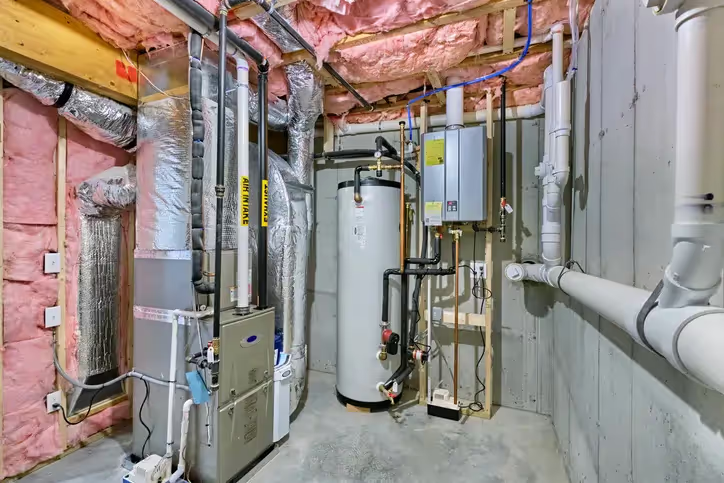
5 Signs You Need A Furnace Replacement
Furnace replacement service usually takes 4-5 days to install the system in your household properly. That’s why our experts furnace replacement in Kansas City recommend that residents not wait for…
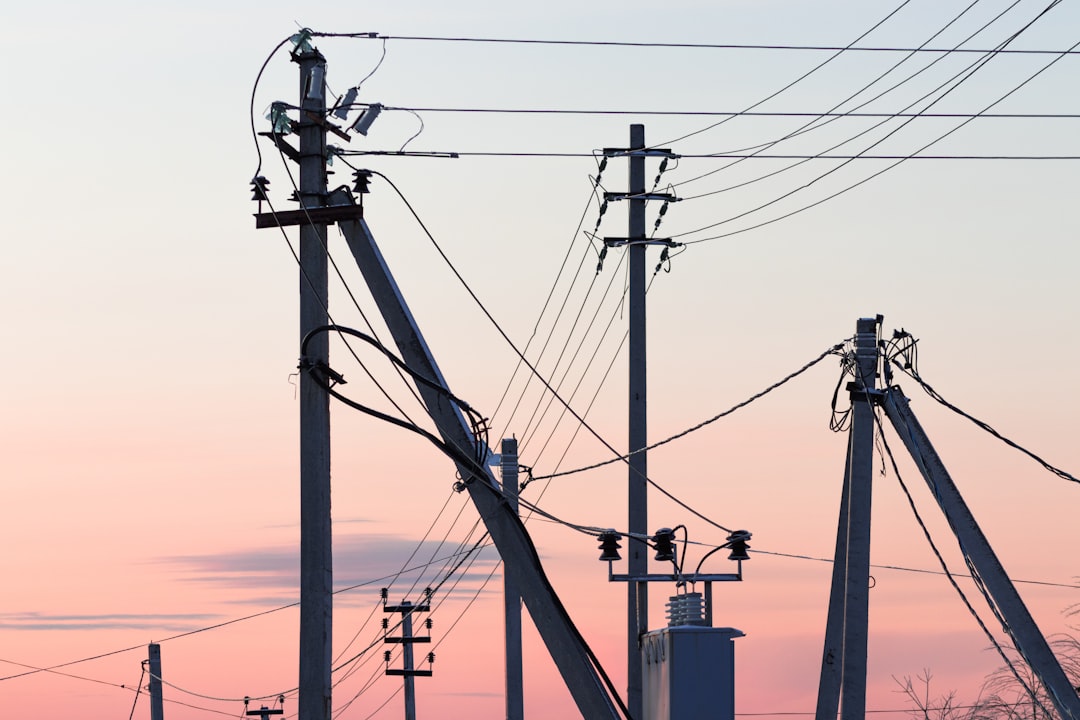
How power outages affect your systems is something every Johnson County homeowner should understand before the next summer storm hits — not after.
Here's a quick breakdown of the most common damage power outages cause to home systems:
Power outages are far more common than most people realize. According to federal data, the average U.S. household loses power for nearly 470 minutes per year — and major outages have increased tenfold since the 1980s. Over 83% of outages are weather-related, making summer storm season in the Kansas City area one of the riskiest times of year for your home's systems.
The damage isn't always obvious in the moment. Often, it's the power surge when electricity returns — not the outage itself — that causes the most harm to sensitive equipment like HVAC compressors and electronics. That's what makes understanding and preparing for outages so important for homeowners with aging systems.
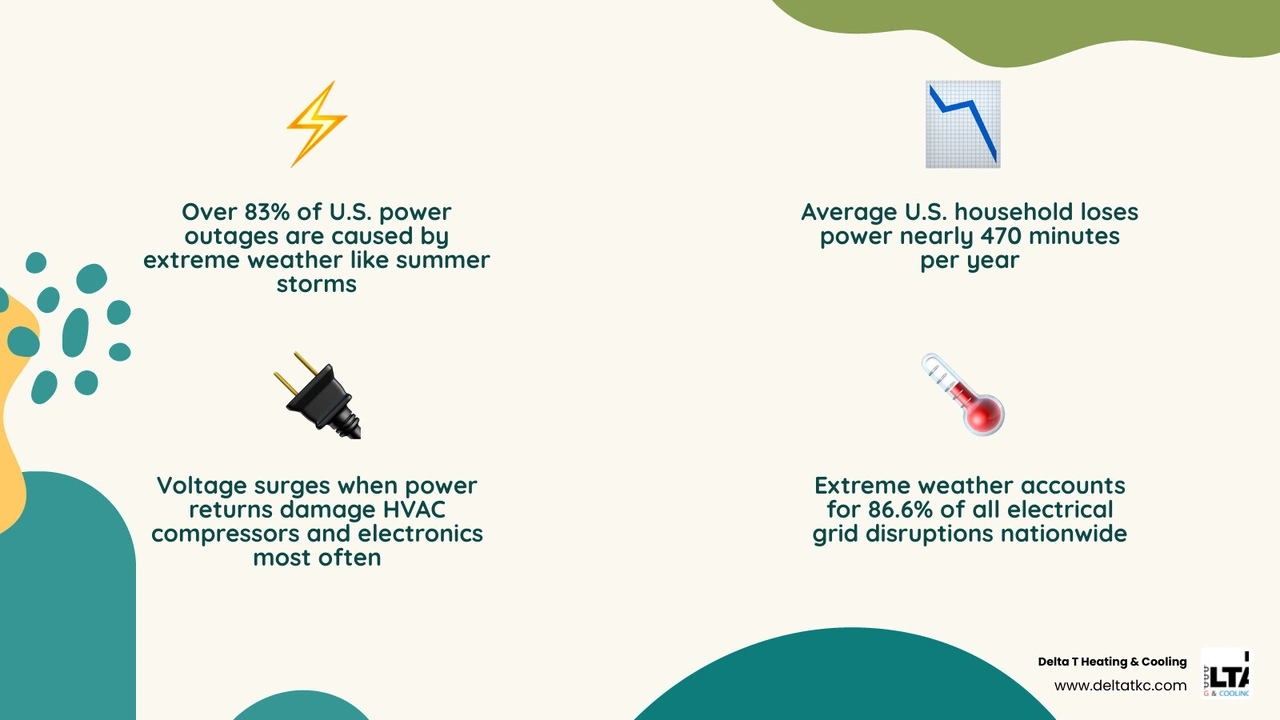
To protect our homes, we first need to understand why the electrical grid fails. In the United States, the power grid is a complex, aging machine under constant stress. When we look at the core causes of power outages, extreme weather and natural disasters account for a staggering 86.6% of all electrical disruptions.
Heavy rain, high winds, lightning, and summer storms put immense physical strain on local infrastructure. In places like Shawnee, Overland Park, and Olathe, fast-moving summer storm fronts can easily bring down tree branches onto power lines, causing localized blackouts. Additionally, during peak summer heat waves, high demand for air conditioning pushes the grid to its limits, resulting in brownouts or planned rolling blackouts to prevent total system collapse.
But grid failures do not just leave us in the dark; they have a massive ripple effect on our communities. When the power goes out, the impacts are felt across several critical areas:
When utility power cuts out, the immediate silence in your home can be golden — but the electrical threat to your equipment is just beginning. Understanding how power outages affect your systems requires looking closely at what happens to your home's electrical wiring during these events.
The primary hazard is not actually the loss of power, but the unstable voltage fluctuations that accompany it. When a power line is severed or a transformer blows, the current does not always vanish instantly. Instead, it can flicker, sag (a brownout), or surge violently.
When the utility company successfully repairs the line and restores service, a massive rush of electricity — known as a voltage spike or power surge — travels down the line. This spike carries thousands of volts, easily bypassing standard household breakers and heading straight for your most sensitive appliances.
Without proper surge protection for residential properties, these surges melt delicate circuit boards, degrade wiring insulation, and severely shorten the lifespan of your mechanical systems.
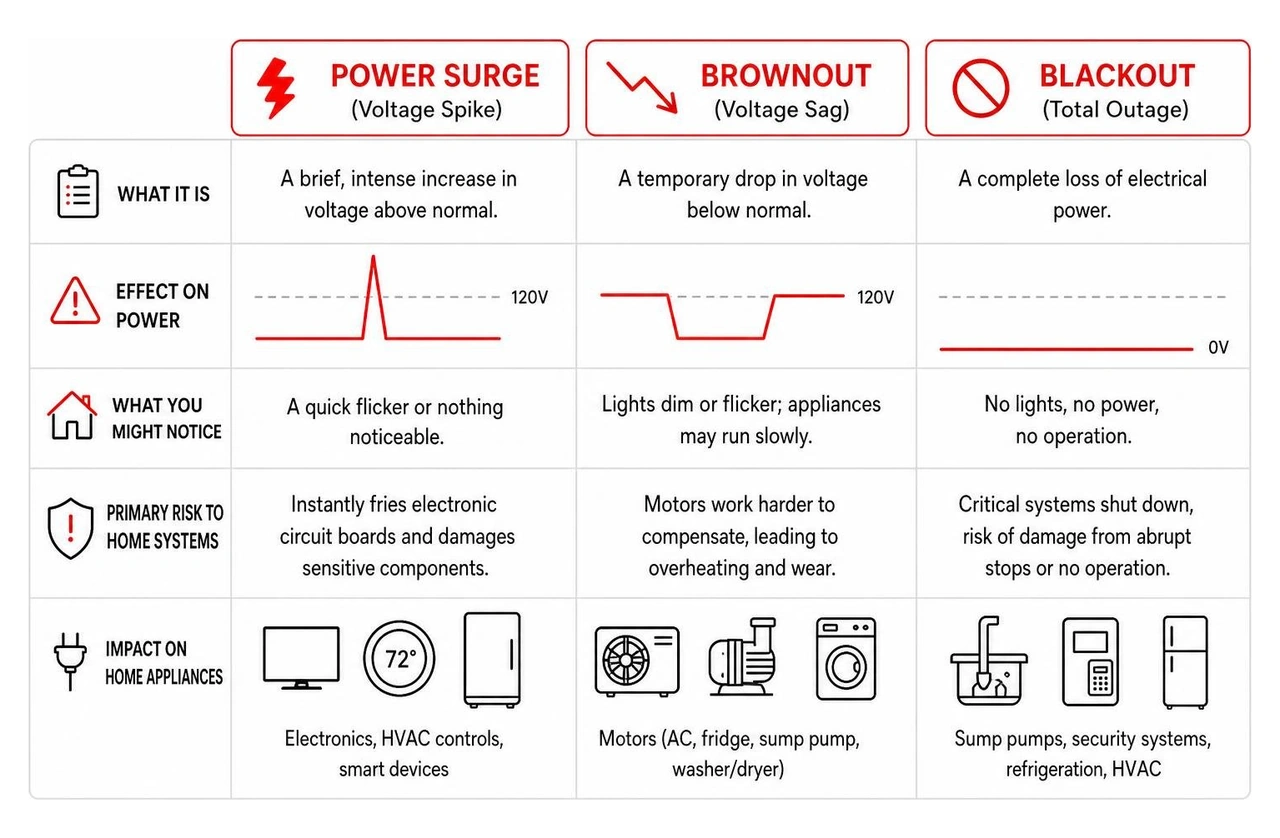
| Power Event | What It Is | Primary Risk to Home Systems |
|---|---|---|
| Power Surge (Voltage Spike) | A brief, intense increase in electrical voltage well above the standard 120-volt level. | Instantly fries electronic circuit boards, damages compressor motors, and ruins smart thermostats. |
| Brownout (Voltage Sag) | A temporary drop in voltage flow, often causing lights to dim or flicker. | Forces motors (like your AC compressor) to draw more current to compensate, leading to rapid overheating. |
| Blackout (Total Outage) | A complete loss of electrical power to the property or wider area. | Shuts down critical safety systems like sump pumps, leading to data loss and abrupt mechanical stops. |
Your air conditioner and heating systems are particularly vulnerable to sudden power losses and the subsequent surges. Inside your outdoor condenser unit sits the compressor — the expensive "heart" of your cooling system — alongside the fan motor and the capacitor.
When the power drops out abruptly while your AC is running, the system is forced into an immediate, hard stop. This can disrupt the pressure balance of the refrigerant. If the power quickly flickers back on and off (a common occurrence during summer storms), the system may attempt to restart while still under high internal pressure. This is known as "short cycling."
Short cycling forces the compressor motor to work incredibly hard, drawing excessive electrical current. This can lead to:
If your system experiences a hard shutoff during extreme weather, you might find yourself needing an emergency HVAC repair to get your home back to a safe temperature. Knowing how to handle these unexpected HVAC breakdowns is essential to keeping your cool when the local grid fails.
While your HVAC system represents the largest mechanical investment in your home, your smart electronics and computers are the most delicate.
When a computer, server, or smart home hub loses power unexpectedly, it cannot complete its controlled shutdown sequence. Operating systems keep critical system files open in temporary memory (RAM) while running. An abrupt shutdown prevents these files from being written back to storage correctly, leading to severe data corruption. In older mechanical hard drives, a sudden loss of power can cause the physical read/write head to crash directly onto the spinning magnetic platter, permanently ruining the drive.
Modern smart thermostats are essentially small computers mounted on your wall. While many models feature backup batteries, a violent power surge upon grid restoration can scramble their internal firmware, reset your customized comfort schedules, or fry the connection terminals that communicate with your heating and cooling equipment.
To safeguard your digital life and home comfort, protecting against abrupt computer power loss and investing in reliable smart thermostats with built-in surge protection are critical steps for any modern homeowner.
The best time to handle a power outage is before the first drop of rain falls. By taking proactive, preventive steps, you can significantly reduce the risk of expensive appliance damage and keep your family safe.
A well-maintained HVAC system is far more resilient to electrical anomalies. During a routine tune-up, a professional technician will inspect your system's electrical connections, test the capacitors, and clean the coils. Clean coils allow your system to run shorter, more efficient cycles, which reduces baseline wear and tear and makes the motors less likely to overheat during a brownout. Taking time for preventing HVAC emergencies is the foundation of home utility resilience.
Do not rely solely on cheap power strips. True electrical safety requires a two-tiered approach:
If you live in an area prone to frequent grid issues, consider installing a standby generator or an Uninterruptible Power Supply (UPS) system. A UPS acts as a temporary battery buffer, giving you 5 to 30 minutes of clean power to gracefully shut down your computers and protect storage drives from corruption. For larger systems, a whole-home standby generator with an automatic transfer switch can keep your HVAC running and your sump pump online during extended outages.
If you plan to use a portable generator during an outage, safety is paramount. Always place portable generators outdoors, at least 20 feet away from any windows, doors, or vents to prevent deadly exhaust fumes from entering your living spaces. Ensure you have working carbon monoxide detectors with battery backups installed on every level of your home, as outlined in federal emergency preparedness tips.
When the lights finally flicker back on, your first instinct might be to celebrate and turn everything back on. However, the first few minutes of power restoration are actually the most dangerous for your home's systems. The grid is often highly unstable during this "warm-up" period, and secondary surges are common.
Follow these safe steps to bring your home back online:
Yes. While the loss of power itself simply causes the system to shut down, the electrical surges and brownouts that often occur right before or immediately after an outage can cause severe damage.
These voltage spikes can burn out the sensitive control boards, destroy the capacitors, and melt the internal motor windings of your compressor. Installing a hardwired, dedicated HVAC surge protector directly at your outdoor disconnect box is the most effective way to shield your cooling system from this type of damage.
We highly recommend waiting 5 to 10 minutes after your lights come back on before turning your heating or cooling system back on. This brief delay gives the utility grid time to stabilize and ensures that any initial voltage fluctuations or secondary outages have passed. It also allows the refrigerant pressures inside your air conditioner to equalize safely, preventing harmful short cycling.
There are several key warning signs that your heating or cooling system has sustained electrical damage after a storm:
If you observe any of these symptoms, turn the system off immediately and contact a professional technician for a diagnostic check.
Understanding how power outages affect your systems is the first step toward building a safer, more resilient home. From protecting your expensive HVAC compressor to securing your family's smart devices and appliances, a little proactive planning goes a long way. By investing in regular seasonal maintenance, installing reliable surge protection, and following safe startup procedures after an outage, you can avoid unexpected breakdowns and keep your home comfortable year-round.
If you are experiencing frequent power disruptions or want to make sure your home's heating and cooling systems are fully prepared for the next big storm, our team at Delta T Heating & Cooling is here to help. We proudly provide prompt, honest, and professional HVAC services across Johnson County, including Olathe, Lenexa, Shawnee, Overland Park, and Leawood.
Whether you need a seasonal tune-up, emergency repairs, or expert advice on protecting your equipment, we are committed to keeping your home safe and comfortable.
Ready to protect your home's heating and cooling systems from unpredictable summer storms? Contact Delta T Heating & Cooling today to schedule your professional HVAC services and ensure your system is surge-ready! If you are currently experiencing issues after a recent storm, please visit our Kansas City AC service page to get your cooling back on track.
See what our happy customers have to say!

Mike and his apprentice always do excellent work. Prompt, efficient, honest and dependable. I recommend without qualification!
I own several rental homes throughout Johnson County and exclusively use Delta T to service and install at all my properties and my personal residence. Have referred them to several friends, family and coworkers without hesitation. Professional, efficient and always come through with high quality work at an affordable price.
We were very pleased with Adam and the crew. We found them knowledgeable, professional and competitive in price and we’re happy to recommend them.
Good experience with Delta T Heating & Cooling. Service Tech Garrett was on time, professional, and personable.
After getting several estimates and talking with 3 other companies, it was clear Delta T was the right company to replace our aging furnace and AC unit. They offered a very competitive price but what really impressed me was Adam’s knowledge, attention to detail and desire to make sure the installation was perfect. I highly recommend these guys, you won’t be disappointed.
They were great! Garrett the technician was very nice and thorough. I was able to make an appointment quickly, and their prices were reasonable!
I was so impressed With Delta T Heating & Cooling. They were a phenomenal company to work with and I will continue to use them! Thank you so much to Adam for taking care of our AC!
Great service. They gave me 3 options for my house. Explained the differences and installed a great system. They did great work at a great price. Love the new HVAC.
Greatest crew! Very knowledgeable, and were QUICK to get my issue resolved-Thank you Adam, for getting me scheduled so quick-and thank you Mike & Garrett for your expertise and quick resolve
Delta T is my “go-to” HVAC service company. Always very prompt and extremely reasonable on price. You will be glad you called Delta T.
Every interaction with Delta T has been very positive and helpful! Mike went goes and beyond to help explain things & the maintenance plan has been very beneficial for us! Highly recommend!
Delta T has provided service for my HVAC system and water heaters at multiple properties for the last 4 years. Quick service, good communication, fair prices. I trust them implicitly.
The tech came and checked our heating system, got it all ready for winter, and explained everything I needed to know, for a reasonable price. Bonus, he also explained 2 or 3 ways why upgrades wouldn’t be necessary, and how to prolong the life of the system. Will definitely continue to use them.
They fit me in their schedule pretty late at night. Theres a storm coming and they were understanding and fixed my issue quickly. I purchased their program to have them come out annually now. Thank you guys!
Mike Jeanneret was our repairman and he thoroughly explained everything he was doing and why he was doing it. He didn’t charge us for anything we didn’t need and I feel confident that he was honest with his work. Would recommend to anyone!
I’ve used Delta for several years both at both my personal residence and my work building. They have always responded quickly and efficiently. I’ve been so happy with their service and never trust anyone else
Mike is absolutely the best! Honest, kind and very professional. I've dealt with a few other companies before going with Delta T....it was like night and day! So refreshing to deal with an honest and affordable company. Thank you so much!!!
Punctual, courteous, prompt & reliable service - the perfect recipe for great service! Highly recommend to others!
Mike Jeanneret was/is absolutely fantastic He spent as much time as necessary, and then a bit more to explain everything that he did and all the ins and outs of our system. We use DeltaT for yearly maintenance, and could not be happier. Highly recommend Mike and DeltaT
Efficient, knowledgeable, reasonably priced. Garrett and Daniel were very helpful and were fantastic at explaining things to me. Highly recommend.