When to Change Your HVAC Air Filter: Ultimate Guide
Delta T Heating & Cooling
Learn when to change your HVAC air filter with this guide on timing, thickness, household factors, and consequences of neglect.
The Simple Truth About When to Change Your HVAC Air Filter (Most Homeowners Get This Wrong)
Knowing when to change your HVAC air filter is one of the easiest ways to protect your system, lower your energy bills, and keep the air in your home clean. For most homeowners in Johnson County, the answer depends on a few key factors — but here's a quick breakdown to start:
How often should you change your HVAC air filter?
| Home Situation | Recommended Change Frequency |
|---|---|
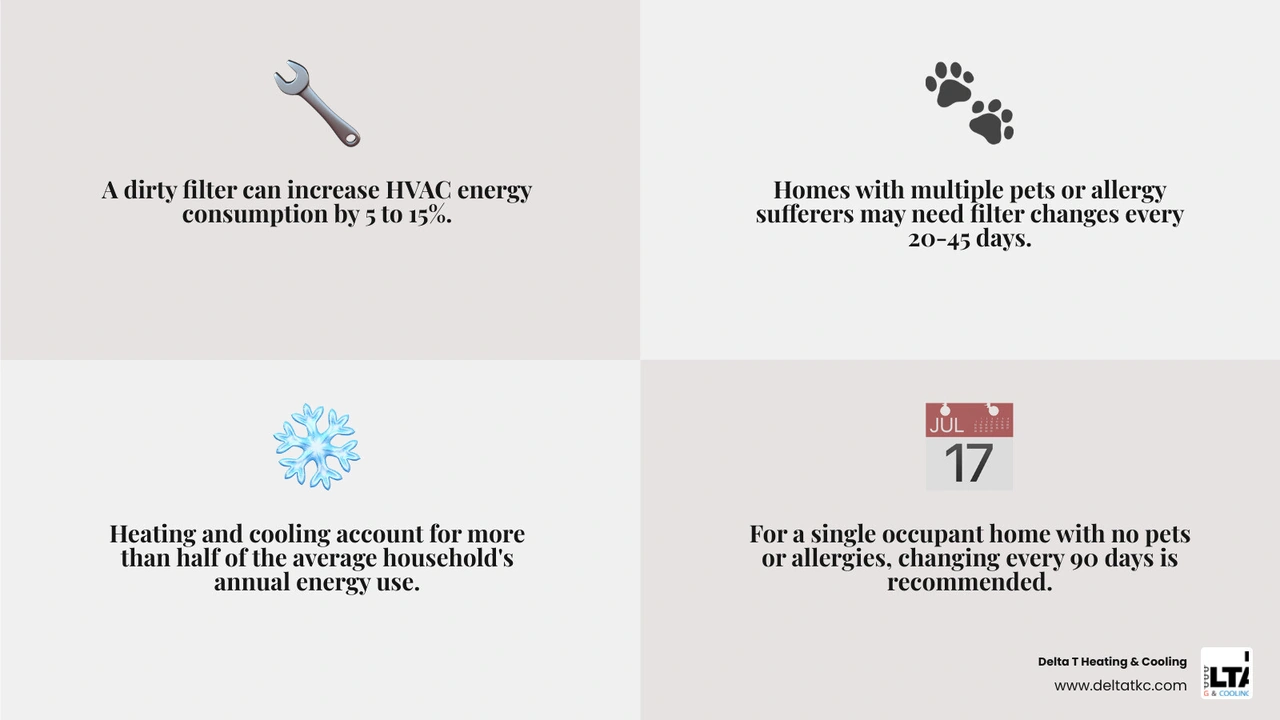
| Single occupant, no pets, no allergies | Every 90 days |
| Average family, no pets | Every 60-90 days |
| One pet in the home | Every 60 days |
| Multiple pets or allergy sufferers | Every 20-45 days |
| Asthma sufferers | Every 20-45 days |
| Vacation home or rarely used | Every 9-12 months |
| 4-5 inch thick media filter | Every 6-12 months |
These are starting points. Your actual schedule may be shorter depending on your filter type, your home, and the time of year.
Most homeowners don't think about their HVAC filter until something goes wrong — a spike in the energy bill, weak airflow from the vents, or worse, an unexpected breakdown during a Kansas City summer. A clogged filter forces your system to work harder than it should, and that extra strain adds up fast. According to the U.S. Department of Energy, a dirty filter can increase your HVAC system's energy consumption by 5 to 15 percent. And since heating and cooling already account for more than half of the average household's annual energy use, that's not a small number.
The good news? Staying on top of filter changes is one of the simplest, most affordable things you can do to keep your system running smoothly year-round.
When to change your hvac air filter definitions:
Determining When to Change Your HVAC Air Filter
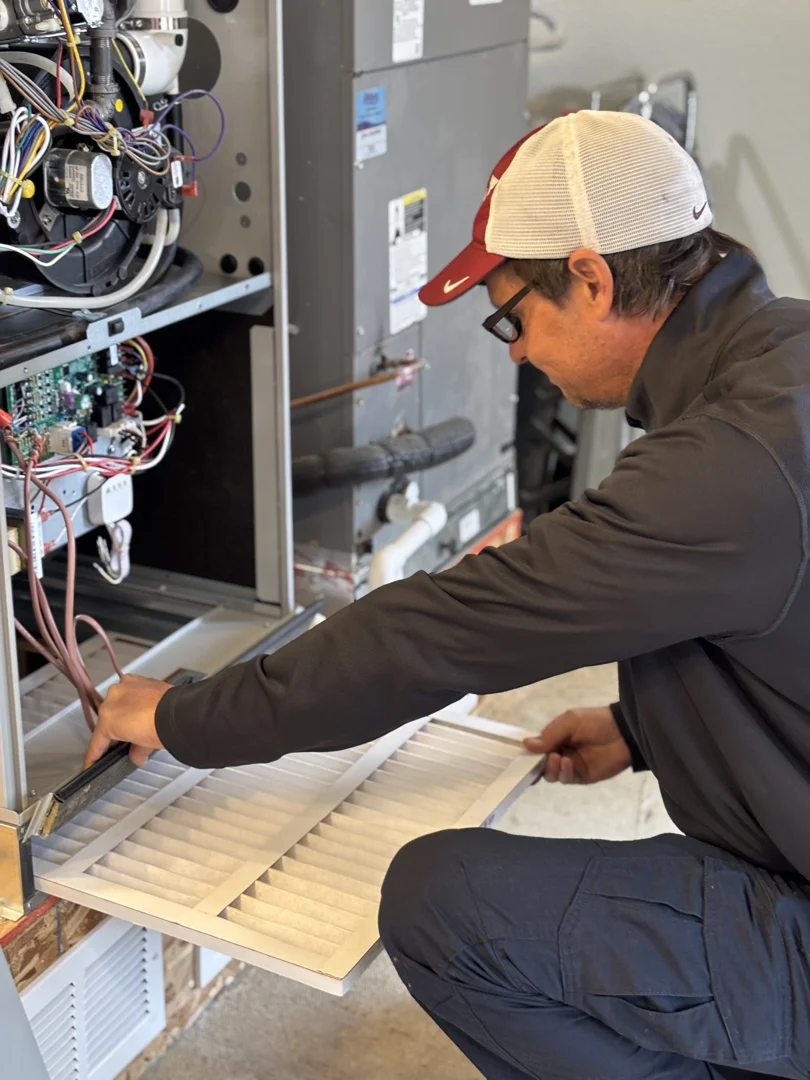
While calendar guidelines are incredibly helpful for establishing a baseline, we always tell our neighbors in Lenexa, Olathe, and Overland Park that conditions should lead while calendars follow. The general rule of thumb to replace your filter every 30 to 90 days is a safe starting point, but relying solely on a date written on your calendar can sometimes lead to trouble.
To truly master your home's air quality and protect your heating and cooling system, you need to rely on physical inspections. The most reliable way to check your filter's health is the "light test." Simply slide the filter out of its slot and hold it up to a bright light source or a window. If the light struggles to pass through the pleated material, or if the filter has turned an ashen gray color and is coated in a thick layer of dust, it is completely loaded. At this point, it is actively restricting your system's airflow and needs to be replaced immediately.
For a deeper dive into establishing your home's custom timeline, review our comprehensive guide on How Often Should You Change Your HVAC Air Filter.
How Filter Thickness Affects When to Change Your HVAC Air Filter
When you head to the local hardware store in Shawnee or Leawood, you will find a massive variety of filters. The physical thickness of the filter is one of the primary drivers of how long it will last.
- 1-Inch Fiberglass Filters: These are the thin, green or blue spun-fiberglass filters. They are incredibly cheap, but they offer very little surface area. They are designed primarily to keep large debris, like pet hair and giant dust bunnies, out of your system's blower motor. They do almost nothing to improve indoor air quality. Because they have so little holding capacity, they must be replaced every 30 days without exception.
- 1-Inch Pleated Filters: These are made of folded paper or synthetic fibers, which greatly increases the surface area available to trap particles. They are the most common choice for residential homes and typically last between 30 and 90 days.
- 4-Inch to 5-Inch Media Filters: Often installed in specialized media cabinets right next to your furnace or air handler, these thick, accordion-style filters have a massive amount of surface area. Because "surface area is queen" when it comes to filtration longevity, these filters can easily last 6 to 12 months before needing a swap. However, we still recommend inspecting them quarterly, especially during peak heating and cooling seasons.
Household Factors That Dictate When to Change Your HVAC Air Filter
Every home in Johnson County is unique, meaning a schedule that works perfectly for a quiet, pet-free townhouse in Mission might fail miserably for a bustling, multi-pet household in Leavenworth. Here are the primary household variables that will accelerate your filter replacement schedule:
- Furry Family Members: Pets are wonderful, but from an HVAC perspective, they are essentially walking "dust and dander factories." Dog and cat hair, along with microscopic dander, will clog a standard pleated filter much faster than dust alone. If you have multiple shedding pets, your filter should be checked every 30 days and replaced at least every 45 days.
- Allergies and Asthma: Around 28 million Americans live with asthma — roughly one in twelve people. If anyone in your home suffers from respiratory issues, seasonal allergies, or asthma, keeping a fresh filter in place is crucial. Saturated filters lose their electrostatic charge and will eventually begin bypassing particles, allowing allergens to recirculate. For sensitive individuals, we recommend replacing high-quality pleated filters every 20 to 30 days.
- Indoor Pollutants: Smoking indoors, burning scented candles frequently, and heavy cooking with oils all release fine particulates into the air. These sticky substances settle on the filter media, binding dust together and sealing up the airflow pathways much faster than normal.
- Seasonal and Environmental Changes: During the spring pollen explosion or periods of heavy wildfire smoke drifting across the Midwest, your HVAC system's fan often runs constantly. This dramatic increase in throughput means your filter is capturing far more particles per hour, requiring a much quicker turnaround.
For more tips on tailoring your filter maintenance to seasonal changes, refer to our Spring Air Filter Replacement Guide.
The Consequences of Neglecting Your Air Filter
It is easy to forget about a filter tucked away in a dark basement slot or a hallway ceiling grate. However, neglecting this simple task can trigger a domino effect of mechanical issues, indoor air quality problems, and financial headaches.
When your air filter becomes completely clogged with dirt and debris, it acts like a wall inside your ductwork. Your HVAC system's blower motor has to work incredibly hard to pull air through this resistance. This increased "static pressure" places immense mechanical stress on the motor, causing it to run hot, consume significantly more electricity, and eventually burn out prematurely.
In the summer, restricted airflow is the leading cause of frozen AC evaporator coils. Your air conditioner relies on a steady stream of warm indoor air passing over the cold copper coils to absorb heat. Without that warm airflow, the moisture on the coils quickly drops below freezing, turning the entire unit into a solid block of ice. This can lead to liquid refrigerant flooding back into the compressor, which can destroy the heart of your air conditioning system.
In the winter, that same lack of airflow will cause your furnace to overheat. When the heat exchanger cannot transfer its heat to the passing air, the system will hit its high-limit safety switch and shut down. This constant cycle of overheating and rapid cooling ("short cycling") will eventually cause the metal of your heat exchanger to fatigue and crack, presenting a serious carbon monoxide hazard.
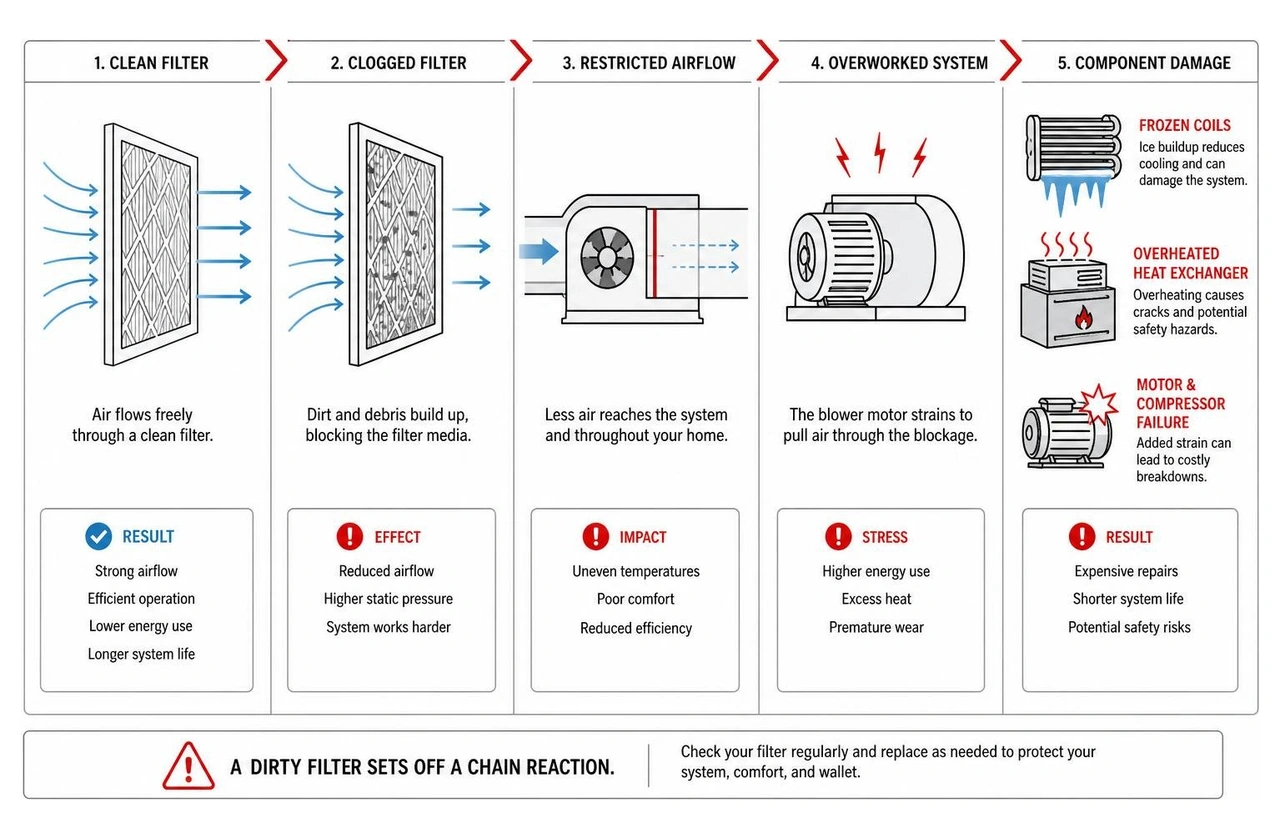
To understand how this dynamic directly impacts local homes during our extreme Midwestern weather, read about How a Dirty Filter Causes Your AC to Run Constantly in the Midwest and the long-term dangers outlined in What Happens If You Skip HVAC Maintenance.
Here is a quick comparison of how a clean filter keeps your system safe versus the damage a dirty filter can inflict:
| HVAC Component | With a Clean Filter | With a Clogged/Dirty Filter |
|---|---|---|
| Blower Motor | Runs cool, operates efficiently, and reaches its full expected lifespan. | Overworks against high resistance, overheats, and suffers premature motor failure. |
| Evaporator Coil | Absorbs heat smoothly, manages indoor humidity, and stays ice-free. | Lacks warm airflow, drops below freezing, and develops a thick layer of ice. |
| Heat Exchanger | Dissipates heat safely into your home, preventing thermal stress. | Overheats rapidly, triggers safety shut-offs, and risks cracking over time. |
| Indoor Air Quality | Actively captures airborne dust, pollen, pet dander, and mold spores. | Reaches capacity, begins bypassing particles, and permits dust to settle in your ducts. |
| Energy Consumption | Operates at peak efficiency, keeping your monthly utility bills manageable. | Forces the system to run longer, increasing energy usage by 5% to 15%. |
Choosing the Right MERV Rating for Your Home
MERV stands for Minimum Efficiency Reporting Value. This rating scale ranges from 1 to 16 for standard residential filters and measures how effectively the filter media traps particles of various sizes.
While it might seem logical to buy the highest MERV rating available to get the cleanest air possible, doing so without professional guidance can actually damage your system. High-MERV filters (such as MERV 13 to 16) have incredibly dense fibers designed to trap microscopic particles like bacteria, smoke, and virus-carrying droplets. Because the weave is so tight, these filters naturally introduce a high level of airflow resistance.
If your HVAC system's blower motor was not designed to handle that level of static pressure, installing a MERV 13 filter is equivalent to putting a cardboard barrier in your return vent. It will restrict airflow, strain the motor, and potentially cause your system to freeze up or overheat.
For most residential systems in Johnson County, we find that a MERV 8 to MERV 11 filter is the absolute sweet spot. It provides excellent filtration of common household allergens — like dust, pollen, and pet dander — without choking your system's airflow. If you want to dive deeper into selecting the perfect balance of filtration and airflow for your specific heating and cooling setup, check out our guide on the Best Air Filter for Your Home.
Frequently Asked Questions about HVAC Air Filters
Can I clean and reuse a disposable air filter?
No, you should never attempt to clean and reuse a disposable cardboard-framed filter. These filters are made of paper or synthetic fibers designed to hold onto dust permanently. Vacuuming them or blowing them out with compressed air will tear the delicate fibers, creating invisible holes that allow dust to bypass the filter entirely. Washing them with water will destroy the filter's structural integrity and can trap moisture within the media, creating a perfect breeding ground for mold and mildew that your system will then distribute throughout your home.
If you are interested in a reusable option, you must purchase a filter explicitly labeled as "washable" or "electrostatic." These feature durable plastic or metal frames and specialized woven mesh. Washable filters must be cleaned monthly, allowed to dry completely before reinstallation, and generally do not capture fine allergens as effectively as high-quality disposable pleated filters.
How do I find the correct filter size for my system?
The easiest way to find your filter size is to turn off your system, slide out your current filter, and look at the dimensions printed on the cardboard frame. You will see a set of numbers that looks like "20x25x1." This is the nominal size, which is a rounded number used by manufacturers for easy labeling.
If you measure the filter with a tape measure, you will find the actual dimensions are usually about a quarter-inch smaller (e.g., 19.5 x 24.5 x 0.75). This slight difference is intentional, allowing the filter to slide easily into the slot without binding. Always buy your replacements based on the printed nominal size. If your current filter does not have dimensions printed on it, measure the physical filter slot length, width, and depth. Make sure your new filter fits flush against the edges; even a small gap will allow air to bypass the filter, leaving your system unprotected.
What are the immediate signs that my filter needs to be changed?
While checking the calendar is helpful, your home will often drop hints that your filter is overdue for a swap. Here are the most common warning signs to watch out for:
- The Filter is Visibly Gray or Ashen: A fresh pleated filter is bright white. If yours looks like the inside of a dryer lint trap, it has reached its capacity.
- Whistling or Straining Sounds: If you hear a high-pitched whistling or a noticeable straining sound coming from your return air vents when the system kicks on, your blower motor is struggling to pull air through a clogged filter.
- Excessive Dust Around the Home: If you notice a fine layer of dust settling on your furniture and countertops just a day or two after cleaning, or if you see "dust bunnies" gathering on your hardwood floors, your filter is likely saturated and letting dust bypass the media.
- Weak Airflow from Vents: If the air blowing out of your supply registers feels noticeably weaker than usual, restricted airflow at the filter is often the primary culprit.
For professional advice on keeping your system running at peak performance throughout our changing seasons, read our guide on How Often to Change Air Filter as Part of Regular AC Service in the Midwest.
Conclusion
Taking control of when to change your HVAC air filter is one of the most powerful, cost-effective ways to protect your home's comfort and keep your utility bills low. By matching your replacement schedule to your household's unique needs — whether you have shedding pets, allergy sufferers, or are running your system heavily during a classic hot Midwestern summer — you can prevent major mechanical failures before they start.
While regular filter changes are a fantastic DIY task, they are only one part of keeping your heating and cooling system in peak condition. To ensure your electrical connections are tight, your refrigerant levels are correct, and your safety controls are functioning perfectly, regular professional maintenance is essential.
At Delta T Heating & Cooling, we pride ourselves on delivering prompt, honest, and professional service at affordable prices. We serve homeowners across Johnson County and the surrounding areas — including Overland Park, Olathe, Lenexa, Shawnee, Leawood, and Kansas City. We believe in providing detailed explanations so you always know exactly how your system is performing.
Ready to enjoy year-round peace of mind and lower energy bills? Schedule your seasonal maintenance plan with Delta T Heating & Cooling today, and let our friendly team of experts keep your home perfectly comfortable in every season.
Talk to us
Need Help?
Engineer-led diagnosis. Upfront pricing. Free second opinions on outside quotes.
More Articles
View All PostsReady to Get Started?
Whether you need a repair, maintenance, or a new installation, our expert team is here to help.