.webp)


Guide
Beat the KC Heat and Sleet: Home System Tips for Kansas City Homeowners
Why Kansas City's Climate Is One of the Toughest on Home Systems in the Midwest
How Kansas City climate affects your home systems is something every homeowner in the metro needs to understand — because this city doesn't just experience seasons, it collides with them. Arctic air from the north, warm moisture from the Gulf, and wild temperature swings that can flip 40 degrees in a single day all put relentless stress on your furnace, air conditioner, and plumbing year-round.
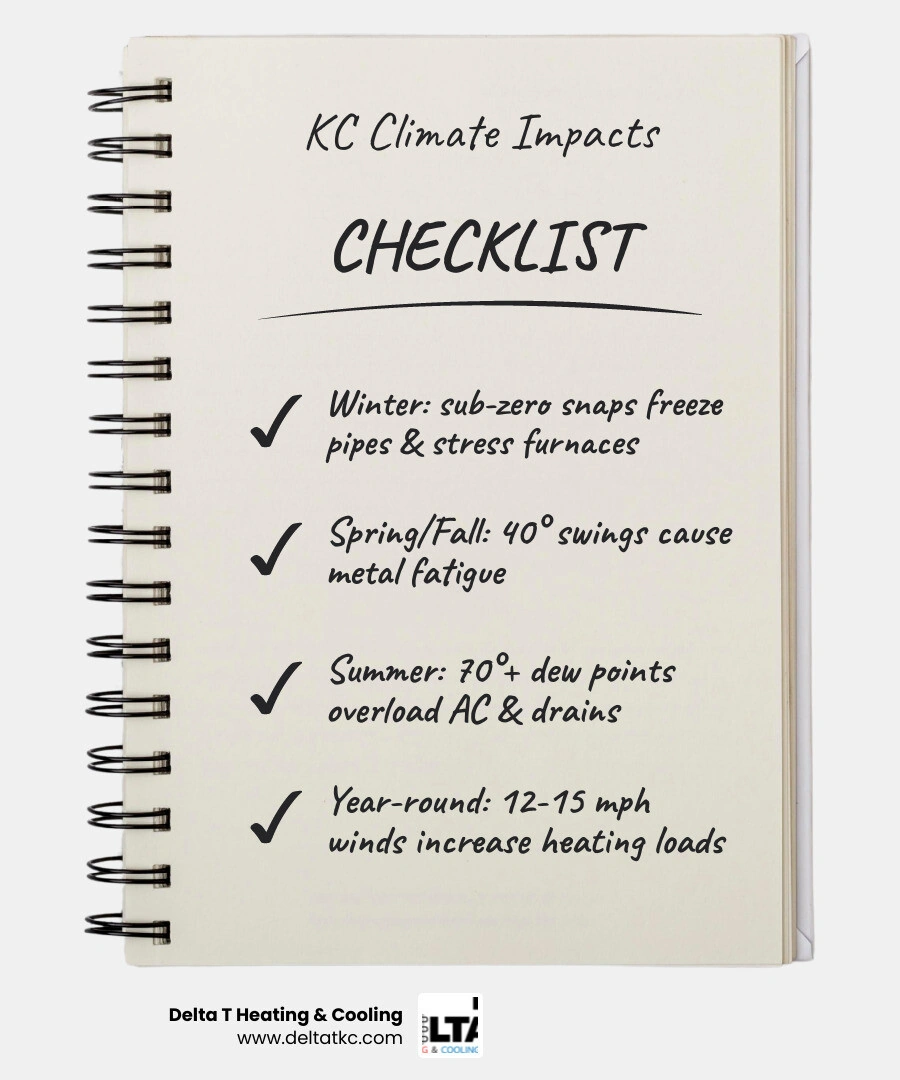
Here's a quick summary of how KC's climate impacts your home systems:
- Winter cold snaps force furnaces to cycle harder and longer, wearing out ignitors and heat exchangers faster
- Sub-zero temperatures cause pipes to freeze and burst, especially on exterior walls
- Rapid temperature swings cause metal components in your HVAC system to expand and contract repeatedly, leading to premature failure
- Summer heat indexes above 100°F push AC compressors to their limits
- July dew points above 70°F force air conditioners to remove heavy moisture loads on top of cooling, accelerating wear
- 12–15 mph average winds drive cold air into homes, raising heating loads significantly
- Heavy spring and summer storms overwhelm sump pumps and drainage systems
Kansas City sits squarely across two IECC climate zones — 4A and 5A — meaning your home has to perform like two different homes depending on the season. That dual demand accelerates wear on every major system faster than homeowners in more stable climates typically expect.
How Kansas City Climate Affects Your Home Systems Across Dual Climate Zones
To truly understand how our local weather shapes the lifespan and performance of your home, we have to look at the map. The International Energy Conservation Code (IECC) places the Kansas City metropolitan area right on the volatile boundary of two distinct climate designations: Zone 4A (mixed-humid) and Zone 5A (cold-humid).
This geographical positioning means we do not have the luxury of preparing our homes for just one type of weather. In places like Overland Park, Olathe, and Lee's Summit, our properties must act as resilient shields against both bone-chilling northern drafts and sticky, tropical southern moisture.
This dual-zone reality is why local leaders have prioritized regional resiliency initiatives. The Climate Action Plan highlights the critical need to upgrade existing residential infrastructure to withstand these shifting, extreme patterns. When we look at how kansas city climate affects your home systems, we see that this mixed-humid to cold-humid transition zone places a constant, alternating load on our heating, cooling, and plumbing setups. For a deeper dive into these seasonal dynamics, check out our guide on How Kansas City Climate Affects Your HVAC and Plumbing.
The Dual-Zone Challenge for Heating and Cooling
Because we straddle Zones 4A and 5A, our HVAC systems must be engineered for extreme versatility. The Kansas City metro experiences between 4,800 and 5,600 heating degree days (HDDs) per year. This measurement reflects how often and how severely outdoor temperatures drop below a comfortable 65°F baseline, indicating a high demand for space heating. This volume of HDDs is significantly higher than what homes in southern Kansas or southern Missouri experience, requiring our furnaces to run for hundreds of additional hours each winter.
Conversely, our summers demand heavy-duty cooling capacity. When designing and installing systems, local HVAC professionals cannot rely on national averages. We must size systems based on precise local design temperatures:
- Winter Design Temperature: 4°F to 7°F (the 99th percentile cold threshold)
- Summer Design Temperature: 99°F (the peak cooling threshold)
If a system is sized incorrectly, the consequences are severe. An oversized air conditioner will short-cycle during moderately warm days, failing to run long enough to pull humidity out of the air, leaving your home feeling damp and clammy. An undersized furnace will run continuously during a January cold snap, driving up utility bills while failing to keep your family warm. Getting this balance right is crucial, which is why we emphasize the importance of Getting the Right Size HVAC for the Kansas City Metro Homes.
Wind-Driven Infiltration and Structural Loads
It is not just the temperature on the thermometer that strains our homes; it is the movement of the air itself. The Kansas City region experiences average year-round wind speeds of 12 to 15 mph. During seasonal transitions and winter cold fronts, these winds act as a giant bellows, forcing cold outdoor air through tiny gaps around windows, doors, and utility penetrations.
This wind-driven infiltration significantly raises your home's heating load. As cold air is pushed inside, warm indoor air is forced out through attic vents and upper-level leaks. This process, known as the "stack effect," forces your furnace to cycle more frequently and run longer to maintain your thermostat's set point. To combat this wind-driven draftiness and keep your utility bills manageable, we recommend focusing on targeted home sealing and insulation upgrades. You can read more about these strategies in our article on how to Maximize HVAC Efficiency for Your Kansas Home.
Surviving the Deep Freeze: Winter Impacts on KC Pipes and Furnaces
When winter settles into the metro, it often brings sudden, deep freezes that put our plumbing and heating systems to the ultimate test. Sub-zero cold snaps are a regular feature of our winters, and preparing your property ahead of time is the best way to prevent catastrophic property damage. You can find a comprehensive winterization roadmap in our guide to Prepare Your Home in Kansas City for Winters.
How Kansas City Climate Affects Your Home Systems During Rapid Temperature Drops
One of the most destructive aspects of our local weather is the speed at which it changes. It is not uncommon for a strong cold front to sweep through the metro, causing a 40-degree temperature drop within a 12-to-24-hour window. This rapid transition is incredibly stressful for mechanical systems due to the physics of thermal expansion and contraction.
Inside your furnace, the heat exchanger is made of metals like steel or aluminum. When the burner ignites, these metal chambers expand rapidly. When the system cycles off, they cool down and contract. Under normal, steady weather conditions, this process occurs at a manageable rate. However, during a sudden 40-degree drop, your furnace is forced to cycle twice as often to keep up with the rapid heat loss. This constant "breathing" of the metal accelerates heat exchanger fatigue, which can eventually lead to hairline cracks. A cracked heat exchanger is a serious safety hazard, as it can allow dangerous carbon monoxide gas to leak into your living spaces.
Furthermore, rapid cycling places immense wear and tear on your furnace’s hot surface ignitor. These ignitors function similarly to lightbulb filaments, glowing white-hot to light the gas burners. During extreme temperature swings, the frequent electrical cycling makes these components brittle, leading to sudden failures when you need heat the most. To understand how extreme winter elements like ice and rapid freezes can damage your system, read our detailed analysis on How Ice Storms Damage Your Heating System.
Frozen Pipes and High-Efficiency Furnace "Ice Plugs"
Plumbing systems are equally vulnerable during deep freezes. Water possesses a unique physical property: it expands by approximately 9% when it transitions from liquid to ice. When water freezes inside a copper, PEX, or galvanized steel pipe, it is not the ice itself that immediately ruptures the pipe. Instead, the expanding ice acts as a solid plug, trapping liquid water between the frozen blockage and the closed faucet. As the ice continues to expand, it raises the water pressure to thousands of pounds per square inch, eventually causing the pipe wall to split.
High-efficiency condensing furnaces (those rated at 90% AFUE or higher) face a similar freezing risk. These systems extract so much heat from the combustion process that the exhaust gases condense into liquid water. This acidic condensate must drain out of your home through a dedicated PVC drain line. During prolonged sub-zero cold snaps, if this drain line or the exterior PVC exhaust vent is exposed to freezing drafts, the condensate can freeze solid, creating an "ice plug." When the drain is blocked, safety float switches or pressure sensors inside the furnace will trigger, shutting down the entire heating system to prevent water damage. Keeping these vents clear of snow and ice is a vital winter task for every homeowner.
Managing Summer Heat and Humidity in the Metro
While winter brings the threat of freezing, summer in Kansas City brings a completely different set of challenges. Our summers are characterized by intense heat waves where temperatures regularly climb into the 90s, and high humidity levels make the outdoor air feel thick and oppressive.
How Kansas City Climate Affects Your Home Systems Under High Humidity Loads
In July and August, the dew point in eastern Kansas and western Missouri regularly climbs above 70°F. When this happens, your air conditioner must perform double duty. It cannot simply lower the air temperature (sensible cooling); it must also physically extract gallons of moisture from the air (latent cooling).
This high latent cooling load means your AC compressor must work twice as hard. The compressor is the heart of your cooling system, pumping refrigerant between the indoor evaporator coil and the outdoor condenser coil. High outdoor temperatures raise the operating pressures inside the refrigerant lines, putting extra physical strain on the compressor motor and electrical components. Without regular maintenance to ensure the outdoor coils are clean and able to shed heat efficiently, these elevated pressures can lead to premature compressor failure. For a deeper look at why our local climate shortens equipment lifespans, read our article on Why AC Systems in the Kansas City Area Wear Out Faster Than the National Average.
Additionally, the massive amount of water pulled from your indoor air must flow safely out of your home. Your AC's evaporator coil sits above your furnace, dripping water into a primary condensate pan that drains through a narrow pipe. In our humid climate, this warm, wet environment is a breeding ground for algae and mold. If a clog develops in this drain line, the pan will overflow, leading to water damage on your furnace’s electrical control board or ceiling stains below the unit. This risk is amplified if airflow is restricted by a clogged filter, which can cause the entire coil to freeze into a block of ice. Learn more about how to prevent these issues by reading How a Dirty Filter Causes Your AC to Run Constantly in the Midwest.
Storm Surges and Sump Pump Overload
Summer in the metro also means severe thunderstorms. May and June are typically our wettest months, often bringing heavy downpours that drop several inches of rain in a few hours. This rapid accumulation of water can saturate the soil around your foundation, putting immense hydrostatic pressure on your basement walls.
Your sump pump is your home’s primary defense against this rising groundwater. During a typical heavy summer storm, a sump pump may cycle every few minutes to keep your basement dry. If your pump is old, clogged with sediment, or lacks a battery backup system, a sudden power outage during a storm can lead to immediate basement flooding. Keeping your sump pump tested and installing a reliable backup power source is a critical step in protecting your property. To understand the seasonal rain and storm trends in our area, you can refer to the resource on Weather and Climate in Kansas City MO – Seasonal Trends & Extremes.
Proactive Maintenance Strategies for KC Homeowners
Given the intense physical demands our climate places on residential systems, a proactive approach to maintenance is not a luxury—it is a financial necessity. Regularly servicing your equipment ensures it can handle the sudden transitions from spring storms to summer heatwaves, and from crisp fall days to winter deep freezes. You can read our complete checklist in the Annual HVAC Maintenance Complete Guide.
To help you stay organized, we have compiled a comparison of key seasonal tasks:
| System Component | Winter Maintenance Focus | Summer Maintenance Focus |
|---|---|---|
| Heating & Cooling | Inspect heat exchanger, test ignitor, check safety switches, clear snow from PVC exhaust vents. | Clean outdoor condenser coils, check refrigerant levels, inspect contactors and capacitors. |
| Plumbing | Insulate exposed pipes, disconnect outdoor hoses, install foam spigot covers. | Test sump pump, inspect condensate drain lines for algae, check water heater for sediment. |
| Air Quality | Monitor indoor humidity, service whole-house humidifier pad, replace air filters. | Run exhaust fans, check attic ventilation, replace air filters monthly during peak cooling. |
Combating Low Winter Humidity
While summer brings too much moisture, winter brings the opposite problem. Cold outdoor air holds very little water vapor. When that dry air is pulled into your home and heated by your furnace, the relative humidity (RH) inside can easily drop below 20%. For comparison, the Sahara Desert averages around 25% relative humidity!
This extreme dryness has several negative impacts:
- Home Materials: Wood is a natural sponge that expands and contracts based on moisture levels. When indoor humidity drops below 20%, hardwood flooring, wood trim, and structural framing will shrink, leading to visible gaps, squeaking floors, and cracking crown molding.
- Human Comfort & Health: Dry air evaporates moisture from your skin and respiratory tract, causing dry skin, scratchy throats, nosebleeds, and making you more susceptible to winter viruses.
- Thermostat Perception: Dry air feels colder than humidified air at the same temperature, tempting you to turn up your thermostat and raise your heating bills.
Installing a whole-house humidifier integrated into your furnace is the most effective solution. It injects controlled moisture directly into your ductwork, keeping your home's RH within the ideal 30% to 50% range.
Air Filter and Ventilation Best Practices
Maintaining clean air filters is the simplest yet most critical task for any homeowner. During our peak heating and cooling seasons, your system is moving a massive volume of air. If your filter is clogged with dust, pet dander, or outdoor pollen, your blower motor must work significantly harder to pull air through, leading to overheating and premature motor failure.
We recommend using filters with a MERV (Minimum Efficiency Reporting Value) rating between 8 and 11. These filters provide excellent particle capture—including agricultural dust and seasonal pollen—without restricting airflow. During high-use months, check your filter every 30 days and replace it as soon as it appears dirty. For more guidance on filter schedules, check out our article on How Often to Change Air Filter as Part of Regular AC Service in the Midwest.
Frequently Asked Questions about KC Home Systems
Why does my furnace struggle when the temperature drops suddenly?
When the outdoor temperature plummets rapidly, your home loses heat much faster than it does during a gradual cooling trend. This forces your furnace to run much longer, continuous cycles to maintain your indoor comfort. These extended run times place sudden stress on your heating system, highlighting pre-existing issues that went unnoticed during milder weather—such as a slightly clogged air filter, a weak hot surface ignitor, or a dirty flame sensor. If these components are already near the end of their lifespan, the sudden, heavy workload can cause them to fail completely.
How do I prevent my pipes from freezing during a Kansas City cold snap?
Preventing frozen pipes requires a combination of insulation and active water movement:
- Insulate Exposed Pipes: Wrap foam pipe insulation around water lines in unheated areas like crawl spaces, basements, and garages.
- Disconnect Outdoor Hoses: Always remove garden hoses from outdoor spigots before the first freeze and cover the spigots with insulated foam domes.
- Open Cabinet Doors: During extreme sub-zero forecasts, open the cabinet doors under kitchen and bathroom sinks located on exterior walls to allow warm indoor air to circulate around the plumbing.
- Maintain Thermostat Consistency: Avoid deep temperature setbacks at night when extreme cold is predicted. Keeping your home at a steady temperature reduces the load on your plumbing and heating.
- Let Faucets Trickle: Let a tiny, pencil-lead-thin trickle of water run from the faucet furthest from your main water shut-off valve. Moving water is much harder to freeze, and relieving the pressure inside the line prevents the pipe from bursting even if a partial freeze occurs.
When should I call a professional for weather-related repairs?
While basic maintenance is easy to handle yourself, you should call a professional technician immediately if you experience any of the following warning signs:
- Ice Buildup on Your AC or Heat Pump: If you notice ice forming on your outdoor unit or indoor refrigerant lines during summer, turn the system off and call for service. Running a frozen system can destroy the compressor.
- Loud Banging or Booming Noises: While minor popping sounds can be ductwork expanding, loud metallic banging or booming when your furnace ignites can indicate a serious combustion issue or a cracked heat exchanger.
- Sudden Drop in Water Pressure: A significant, unexplained drop in water pressure during a cold snap often indicates that a pipe has partially frozen and may be close to bursting.
- Frequent System Tripping: If your furnace or air conditioner is tripping your electrical breaker or shutting down repeatedly on its safety switches, do not attempt to bypass these controls. They are designed to prevent fires and major mechanical failures.
Conclusion
Living in the Kansas City metro means enjoying the beauty of all four seasons, but it also means accepting the physical challenges our climate poses to our homes. From the freezing wind-driven drafts of January to the heavy, humid afternoons of July, your HVAC and plumbing systems work tirelessly to keep your family safe and comfortable.
At Delta T Heating & Cooling, we specialize in providing prompt, honest, and professional HVAC repair, installation, and maintenance services across Johnson County and the surrounding metro area. We understand the unique demands of our local dual-climate zones and offer tailored maintenance plans to keep your systems running efficiently year-round.
If you are experiencing cooling issues during a summer heatwave, we provide comprehensive AC repair and tune-ups. For reliable service, visit our AC Service in Kansas City, KS page to get your system back in peak shape.
Don't wait for the next extreme weather event to test your home's limits. Schedule your Kansas City HVAC service today and let us help you stay comfortable, no matter what the Midwest weather throws our way!
Recent Posts
Customer Testimonials
See what our happy customers have to say!

Mike and his apprentice always do excellent work. Prompt, efficient, honest and dependable. I recommend without qualification!
I own several rental homes throughout Johnson County and exclusively use Delta T to service and install at all my properties and my personal residence. Have referred them to several friends, family and coworkers without hesitation. Professional, efficient and always come through with high quality work at an affordable price.
We were very pleased with Adam and the crew. We found them knowledgeable, professional and competitive in price and we’re happy to recommend them.
Good experience with Delta T Heating & Cooling. Service Tech Garrett was on time, professional, and personable.
After getting several estimates and talking with 3 other companies, it was clear Delta T was the right company to replace our aging furnace and AC unit. They offered a very competitive price but what really impressed me was Adam’s knowledge, attention to detail and desire to make sure the installation was perfect. I highly recommend these guys, you won’t be disappointed.
They were great! Garrett the technician was very nice and thorough. I was able to make an appointment quickly, and their prices were reasonable!
I was so impressed With Delta T Heating & Cooling. They were a phenomenal company to work with and I will continue to use them! Thank you so much to Adam for taking care of our AC!
Great service. They gave me 3 options for my house. Explained the differences and installed a great system. They did great work at a great price. Love the new HVAC.
Greatest crew! Very knowledgeable, and were QUICK to get my issue resolved-Thank you Adam, for getting me scheduled so quick-and thank you Mike & Garrett for your expertise and quick resolve
Delta T is my “go-to” HVAC service company. Always very prompt and extremely reasonable on price. You will be glad you called Delta T.
Every interaction with Delta T has been very positive and helpful! Mike went goes and beyond to help explain things & the maintenance plan has been very beneficial for us! Highly recommend!
Delta T has provided service for my HVAC system and water heaters at multiple properties for the last 4 years. Quick service, good communication, fair prices. I trust them implicitly.
The tech came and checked our heating system, got it all ready for winter, and explained everything I needed to know, for a reasonable price. Bonus, he also explained 2 or 3 ways why upgrades wouldn’t be necessary, and how to prolong the life of the system. Will definitely continue to use them.
They fit me in their schedule pretty late at night. Theres a storm coming and they were understanding and fixed my issue quickly. I purchased their program to have them come out annually now. Thank you guys!
Mike Jeanneret was our repairman and he thoroughly explained everything he was doing and why he was doing it. He didn’t charge us for anything we didn’t need and I feel confident that he was honest with his work. Would recommend to anyone!
I’ve used Delta for several years both at both my personal residence and my work building. They have always responded quickly and efficiently. I’ve been so happy with their service and never trust anyone else
Mike is absolutely the best! Honest, kind and very professional. I've dealt with a few other companies before going with Delta T....it was like night and day! So refreshing to deal with an honest and affordable company. Thank you so much!!!
Punctual, courteous, prompt & reliable service - the perfect recipe for great service! Highly recommend to others!
Mike Jeanneret was/is absolutely fantastic He spent as much time as necessary, and then a bit more to explain everything that he did and all the ins and outs of our system. We use DeltaT for yearly maintenance, and could not be happier. Highly recommend Mike and DeltaT
Efficient, knowledgeable, reasonably priced. Garrett and Daniel were very helpful and were fantastic at explaining things to me. Highly recommend.


Blogs
Stay updated with our latest blog posts.