Protecting Your HVAC During Tornadoes and Hail: Essential Tips
Delta T Heating & Cooling
Learn how to safeguard your system with expert tips on protecting your HVAC during tornadoes and hail in Kansas City.
Why Protecting Your HVAC During Tornadoes and Hail Matters in Kansas City
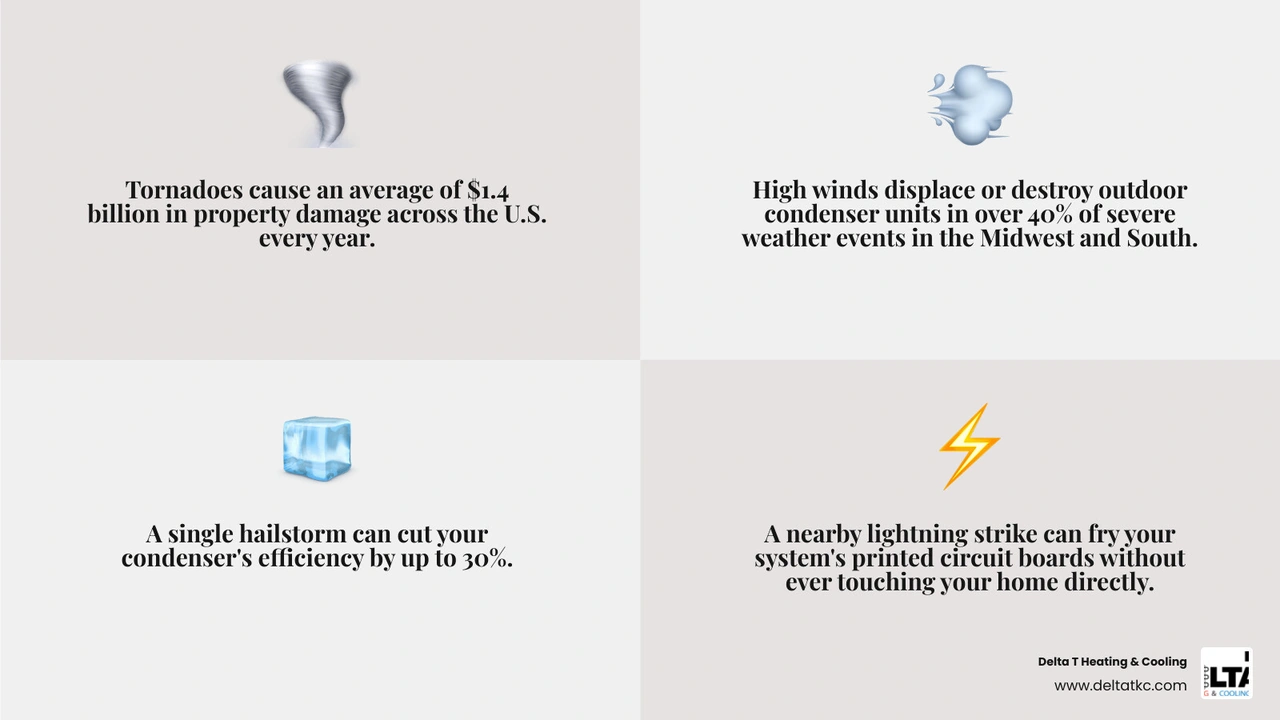
Protecting your HVAC during tornadoes and hail is one of the most important — and most overlooked — steps a Kansas City homeowner can take before storm season arrives. Tornadoes cause an average of $1.4 billion in property damage across the U.S. every year, and high winds displace or destroy outdoor condenser units in over 40% of severe weather events in the Midwest and South. Your HVAC system is often the single most expensive piece of equipment in your home, and it sits outside, completely exposed.
Here is a quick overview of how to protect your system:
- Anchor the outdoor unit to its concrete pad using hurricane straps or tie-down kits.
- Clear the yard of loose items — furniture, tools, planters — that can become wind-driven projectiles.
- Trim trees and shrubs to at least 3 feet from the unit so branches don't become debris.
- Install a surge protector at the breaker panel or outdoor disconnect box to guard against lightning.
- Shut the system off at the thermostat and circuit breaker when a tornado warning is issued.
- Cover the unit with a heavy canvas or vinyl cover during hail — only when the system is fully off.
- Inspect before restarting — check for debris, standing water, bent fins, and unusual damage after the storm passes.
Johnson County sits squarely in storm country, and the Kansas City metro faces significant severe-weather threats every spring and summer. A single hailstorm can cut your condenser's efficiency by up to 30%, and a nearby lightning strike can fry your system's printed circuit boards without ever touching your home directly.
The good news is that most storm damage to HVAC systems is preventable with the right preparation. This guide walks you through everything you need to know — before, during, and after the storm.
How Tornadoes, High Winds, and Flying Debris Threaten Your System
When a severe storm system rolls through places like Olathe, Shawnee, or Overland Park, we tend to focus on our roofs, windows, and basements. It makes sense — those are the structures keeping us safe. However, your outdoor air conditioning condenser is left to fend for itself in the backyard. Understanding how severe weather physically impacts this equipment is the first step toward preventing a total system breakdown.
During a storm, the outdoor unit is vulnerable to three major threats: wind-driven projectiles, physical displacement, and structural stress on the utility lines. When these forces combine, they can turn a perfectly functioning cooling system into a costly pile of scrap metal. To learn more about how local weather patterns impact your property, check out our guide on How Kansas City Severe Weather Affects Your Home Systems.
The Physical Impact of Tornado-Force Winds
Straight-line winds during severe Midwestern storms can easily top 70 to 80 mph, while actual tornadoes exceed 200 mph. These intense forces do more than just rattle your windows. If your condenser unit is not properly anchored, extreme winds can shift the heavy metal cabinet right off its concrete pad.
When a unit shifts or is completely uprooted, it places immense structural stress on the connected utility lines. The copper refrigerant lines are particularly vulnerable. If the unit moves even a few inches, these lines can bend, crimp, or snap entirely. This leads to rapid refrigerant leaks, which are toxic to the environment and can destroy the compressor if the system continues to run. Additionally, electrical conduit lines can be ripped loose, creating immediate electrical and fire hazards.
Why Protecting Your HVAC During Tornadoes and Hail Starts with Debris Mitigation
While the wind itself is a powerful force, the flying debris it carries is often the primary cause of HVAC failure during a tornado or severe thunderstorm. High winds transform ordinary yard items into dangerous high-velocity projectiles. Lightweight patio chairs, garden tools, tree limbs, and even loose gravel can act like shrapnel when launched at your condenser.
This wind-blown debris can smash through the protective grille, cracking the fan blades or knocking the fan motor completely out of alignment. Even smaller debris, like twigs, leaves, and dirt, can get packed deep inside the unit, choking off the airflow.
Protecting Your HVAC During Tornadoes and Hail: Physical Safeguards
Proactive physical protection is your best defense against physical storm damage. By taking the time to anchor your unit and install protective barriers, you can drastically reduce the risk of structural failure when severe weather strikes the Kansas City metro.
One of the most important comparisons to understand is how you cover your unit. Many homeowners mistakenly use standard plastic tarps or winter covers during active storms, which can trap moisture and cause severe damage.
| Feature / Detail | Heavy-Duty Hail Guards | Standard Winter Covers |
|---|---|---|
| Primary Purpose | Deflects hail and flying debris while allowing airflow | Keeps out snow, ice, and leaves during the off-season |
| Material | Thick metal mesh or heavy-gauge steel louvers | Heavy-duty vinyl, plastic, or canvas |
| Airflow Compatibility | High (can remain installed year-round) | None (must NEVER be used while the system is running) |
| Tornado/Wind Resistance | Excellent (permanently mounted to the unit) | Moderate to Low (can catch wind and blow away if loose) |
| Moisture Retention | None (breathable mesh allows water to drain) | High (can trap condensation if left on in humid weather) |
Securing and Anchoring the Outdoor Condenser
If your outdoor unit is simply resting on its pad without any mechanical fasteners, a strong wind gust can easily slide it out of place. To prevent this, we recommend securing the condenser to a level, heavy-duty concrete pad using high-wind tie-down kits or hurricane straps.
These straps are made of heavy-gauge, corrosion-resistant galvanized steel or high-tensile webbing. They anchor directly into the concrete foundation with masonry bolts, wrapping securely over the top or sides of the unit's cabinet. This physical anchoring distributes the wind load evenly and prevents the condenser from tipping, shifting, or being completely displaced by straight-line winds.
Best Practices for Protecting Your HVAC During Tornadoes and Hail
Hail is a major threat to your system's efficiency. The outdoor condenser coil is surrounded by hundreds of delicate aluminum fins. These fins are designed to maximize the surface area for heat exchange, but they are incredibly soft. Even small, pea-sized hail can flatten these fins, while golf ball-sized hail can completely crush them.
Flattened fins restrict the airflow through the condenser coils. This forces your compressor to work significantly harder to cool your home, leading to a massive drop in efficiency, higher utility bills, and eventual compressor burnout. To prevent this, we highly recommend installing heavy-duty metal hail guards. These specialized screens shield the delicate coils from impact without restricting the airflow your system needs to operate.
Electrical Surge and Lightning Protection for HVAC Systems
While physical damage from wind and hail is highly visible, electrical damage from lightning and power surges is often invisible — and just as devastating. Modern HVAC systems are incredibly sophisticated. Unlike older, purely mechanical systems, today's air conditioners and furnaces rely heavily on sensitive printed circuit boards, electronic sensors, and digital communication modules to maximize energy efficiency.
Unfortunately, these advanced electronic components are highly vulnerable to voltage spikes. A nearby lightning strike can send millions of volts surging through the local power grid, finding its way directly into your home's electrical panel. To learn more about safeguarding your home's electrical systems, read about the Importance of Surge Protection Residential Properties.
How Power Surges Damage Sensitive Electronics
A lightning bolt does not need to strike your home directly to cause damage. Lightning-induced surges can travel through power lines from up to a half-mile away from the actual strike zone. When this sudden wave of high voltage hits your HVAC system, it can instantly melt the delicate traces on the printed circuit boards, destroy capacitors, and ruin the electrical windings inside your compressor motor.
Furthermore, power surges don't only happen during the storm itself. When the local power grid goes down, the moment of grid restoration is a prime time for massive voltage spikes. If your system is left switched on when the utility company restores power, the resulting rush of electricity can easily fry your system's electrical controls.
Implementing Whole-Home and Localized Surge Protection
To comprehensively protect your investment, we recommend a two-layered surge protection strategy:
- Whole-Home Surge Protectors: Installed directly at your main electrical breaker panel, these devices act as a primary shield, diverting massive external voltage spikes safely into the ground before they can enter your home's branch circuits.
- Sacrificial HVAC Surge Protectors: Installed locally at the outdoor electrical disconnect box near your condenser, these specialized devices provide a secondary, highly targeted line of defense. They are designed to absorb any residual voltage spikes that slip past the main panel, protecting your expensive compressor and control boards from damage.
Pre-Storm Preparation and Post-Storm Recovery Steps
When severe weather is on the horizon in the Kansas City metro, taking a few systematic steps can mean the difference between a minor storm experience and an expensive emergency repair. Having a clear plan of action allows you to protect your equipment safely without putting yourself in harm's way.
Immediate Actions to Take Before a Storm Hits
When a severe storm or tornado warning is issued for your area, prioritize your safety first. If you have a few minutes before the storm arrives, follow this quick checklist to protect your HVAC system:
- Pre-Cool Your Home: Turn your thermostat down 2 to 3 degrees below your normal setting. This "pre-cools" your home, helping it retain comfortable indoor temperatures longer if you experience a prolonged power outage.
- Power Down the System: Turn off your HVAC system completely at the thermostat.
- Flip the Breaker: Locate your main electrical panel and switch off the dedicated circuit breaker for your air conditioner. This physically disconnects the system from the grid, protecting it from lightning-induced voltage surges and grid-restoration spikes.
- Secure the Perimeter: Quickly store any loose yard items — patio furniture, trash cans, toys, and hanging planters — in your garage or basement so they don't become wind-blown missiles.
Safe Post-Storm Inspection and Restart Protocols
Once the storm has passed and it is safe to go outside, do not immediately flip the breaker back on. Follow these steps to ensure your system is safe to operate:
- Perform a Visual Walk-Around: Check the outdoor condenser for physical dents, fallen tree limbs, or shifted positioning on its concrete pad.
- Check for Debris: Ensure the fan blades are free of twigs, leaves, or mud. Do not attempt to run the system if debris is packed inside the cabinet.
- Smell for Gas: If you have a gas furnace or boiler, sniff around the area for the distinct "rotten egg" smell of a gas leak. If you suspect a leak, leave the area immediately and call your utility provider.
- Apply the 3-Minute Rule: If your power flickered or went out, wait at least three minutes before restarting your system. This allows the internal refrigerant pressures to equalize, preventing extreme strain on the compressor motor.
If you notice obvious physical damage or if your system fails to start up properly, you can learn what to expect during a professional service visit by reading our guide on Emergency HVAC Repair What to Expect.
Managing Water Intrusion and Flooding Risks
Heavy rains and flash flooding are common side effects of severe Midwestern storms. While outdoor AC units are designed to withstand normal rainfall, they are not built to be submerged in standing water. Flash floods present a unique set of hazards for both indoor and outdoor HVAC components.
If floodwaters rise high enough to submerge the lower portion of your outdoor condenser, water can enter the electrical connections and fan motor, causing immediate short circuits. Additionally, floodwaters often carry silt, mud, and corrosive minerals. When this debris dries inside the unit, it can cause severe "wicking" — where moisture and corrosive elements travel up the wiring directly into the control board, creating a latent fire hazard.
For homes with basement-installed furnaces or air handlers, a failing sump pump during a storm can lead to indoor equipment submersion. This can ruin electrical ignition systems, gas valves, and blower motors, while also promoting rapid mold growth within 24 to 48 hours. To understand how our local climate and moisture levels impact your home's mechanical systems, read about How Kansas City Climate Affects Your HVAC and Plumbing.
Frequently Asked Questions about Storm-Damaged HVACs
Should I turn off my AC during a severe thunderstorm?
Yes, absolutely. While normal rain will not harm your outdoor condenser, the lightning and high winds associated with severe thunderstorms pose a major threat. Turning your system off at both the thermostat and the main circuit breaker protects the highly sensitive printed circuit boards and the compressor motor from sudden voltage spikes and power brownouts.
Can I use a cover to protect my AC from hail?
Yes, but only when the system is completely turned off. You can temporarily cover your outdoor unit with a heavy canvas or vinyl cover to shield it from falling hail and flying debris during an active storm. However, you must never run your air conditioner while it is covered. Running the system with a cover on restricts the airflow entirely, which will cause the compressor to overheat and suffer catastrophic damage within minutes.
What are the signs of hidden storm damage to an HVAC system?
Not all storm damage is immediately obvious. Your system might power back on after a storm, but have underlying issues that gradually worsen. Key signs of hidden damage include:
- Unusual Noises: Screeching, grinding, or rattling sounds can indicate that debris has entered the fan cabinet or that the fan blades are out of alignment.
- Oily Residue: Spotting oily patches around the refrigerant lines or on the condenser coils is a primary indicator of a refrigerant leak.
- Spikes in Energy Bills: If your monthly utility bills suddenly jump without a change in usage, your system may be struggling to overcome bent fins or airflow restrictions.
- Short-Cycling: If your AC turns on and off rapidly, it could indicate electrical issues or sensor damage.
Conclusion
Severe weather is a fact of life in the Kansas City metro, but a major HVAC breakdown doesn't have to be. By taking proactive steps to secure your outdoor unit, clear your yard of potential projectiles, and install proper surge protection, you can safeguard your home comfort system against the worst of nature's tantrums.
At Delta T Heating & Cooling, we believe that prevention is always the best policy. Regular maintenance is the single most effective way to identify weak mounting bolts, clearing clearance zones, and ensuring your electrical connections are tight before storm season peaks. To learn more about keeping your system resilient year-round, explore our comprehensive HVAC Maintenance Plan Kansas City KS.
Whether you need a pre-season safety inspection, a surge protector installation, or emergency repairs after a severe storm, our friendly and experienced team is here to help. We provide prompt, honest, and professional service across Johnson County and the surrounding areas.
Don't wait for the next severe weather warning to find out if your system is protected. Schedule professional AC service in Kansas City today, and let us give you the peace of mind you deserve.
Talk to us
Need Help?
Engineer-led diagnosis. Upfront pricing. Free second opinions on outside quotes.
More Articles
View All PostsReady to Get Started?
Whether you need a repair, maintenance, or a new installation, our expert team is here to help.