2026 Repair Vs Replace Your HVAC Decision Guide
Delta T Heating & Cooling
Use this repair vs replace your hvac decision guide to decide if your system needs repair or replacement.
My heating and cooling system is failing in Kansas City. Should I repair or replace it?
The quickest way to decide: consider your system's age and how often it breaks down. If your system is nearing the end of its typical lifespan and requiring frequent attention, replacement is usually the smarter move. If it is relatively young and experiencing an isolated issue, a repair is often the best path forward.
Here's a quick-reference breakdown before we go deeper:
| Situation | Likely Best Choice |
|---|---|
| System under 10 years old, minor issue | Repair |
| System past its typical lifespan with major failure | Replace |
| Cracked heat exchanger or CO risk | Replace immediately |
| R-22 refrigerant system needing major work | Replace |
| 3+ repairs in the past 3 years | Replace |
| System under warranty, isolated failure | Repair |
Every year, millions of homeowners face this exact moment: the HVAC goes down, and suddenly you're staring at a system that feels unreliable. It's rarely a calm decision. It usually happens in the middle of a Kansas City summer or a bitter January cold snap, when comfort feels urgent and the pressure to decide fast is real.
The good news is that this doesn't have to be a gut-feel guess. There are clear, practical frameworks — including age thresholds, repair frequency, refrigerant type, and efficiency ratings — that turn a stressful moment into a straightforward decision. This guide walks through all of them so you can make a confident, sound choice for your home.
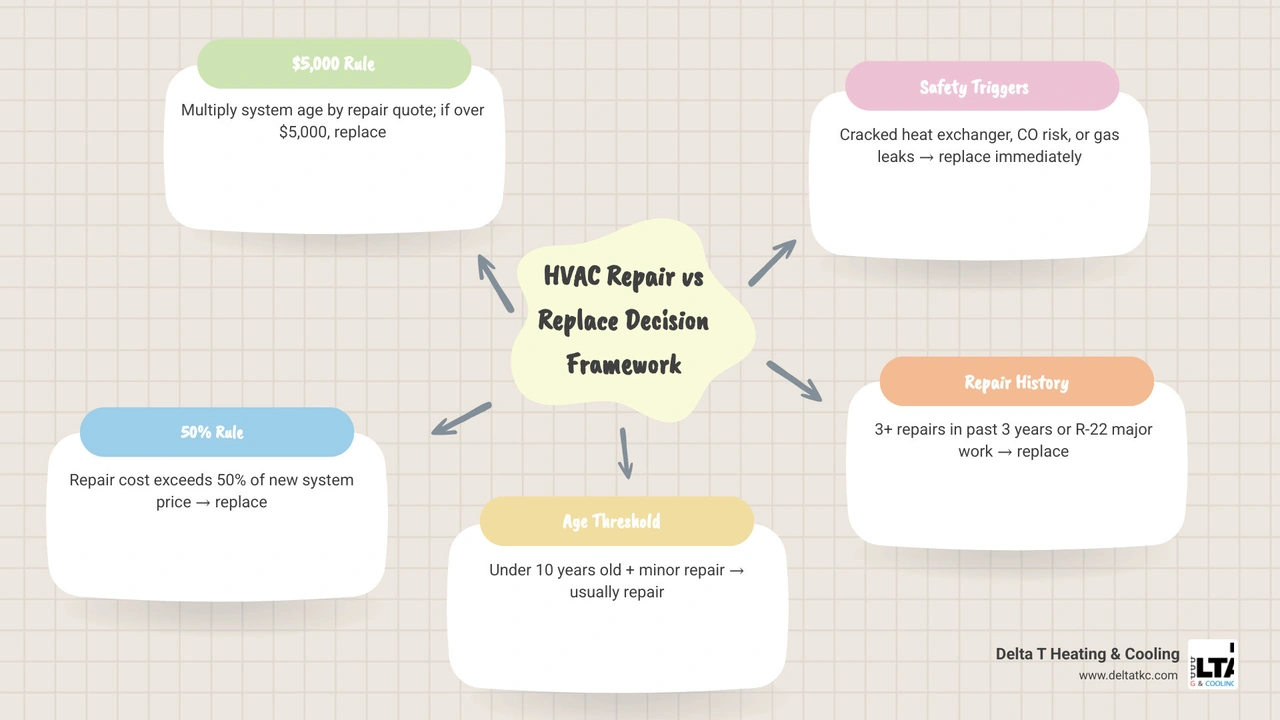
Age and Frequency Guidelines
When you are hit with an unexpected system breakdown, you need a reliable way to cut through the panic and look at your options objectively. Instead of relying on guesswork, industry professionals look at two primary factors: the age of the system and how frequently it requires service.
A good rule of thumb is to evaluate where your system stands in its lifecycle.
- If the system is relatively new and experiencing an isolated issue, making the repair is generally the more sensible choice.
- If the system is nearing the end of its expected lifespan and has a history of repeated breakdowns, investing in a replacement is often the more practical long-term decision.
For example, if your 12-year-old air conditioner needs a minor fix, repairing the unit is often a reasonable choice. However, if that same 12-year-old system suffers a major component failure—such as a seized compressor—investing further in the aging unit may not be the most practical path forward, as other components are likely nearing the end of their operational lives as well.
While these guidelines are fantastic quick-triage tools, they shouldn't be used in a vacuum. They work best when combined with other critical factors like system efficiency, upcoming regulatory changes, and how long you plan to stay in your home.
How System Age Influences Your Decision
The calendar is one of the most honest indicators of your system's reliability. No matter how meticulously you maintain your heating and cooling equipment, physical wear and tear eventually wins. Understanding the typical design lifespans of different HVAC components helps you put any service recommendation into the proper context.
In our experience, central air conditioners and air-source heat pumps typically have a useful life of 10 to 15 years. Gas furnaces are slightly more resilient, often lasting 15 to 20 years, while well-maintained boilers can sometimes push past the 20-year mark.
When your system is in its "golden years," even minor issues can be a sign of systemic fatigue. Patching up a system that is past its expected lifespan is often a temporary band-aid.
Evaluating Repair Frequency
If you feel like you have your local HVAC technician on speed dial, you are likely caught in a "repair spiral." A single issue is an isolated incident; two might be bad luck; but three or more service calls within a three-year window is a clear warning sign that your system is losing its structural integrity.
When evaluating your system, look back at your records from the past few seasons. Have you recently replaced a capacitor, cleared a clogged condensate line, and addressed a minor electrical issue? While these individual fixes might seem minor on their own, their cumulative impact—and the associated stress of repeated breakdowns—quickly adds up.
A system that requires constant attention is not only a drain on your peace of mind, but it is also operating at diminished efficiency, quietly raising your monthly utility usage even when it is "working."
Key Decision Points: When Repairing No Longer Makes Sense
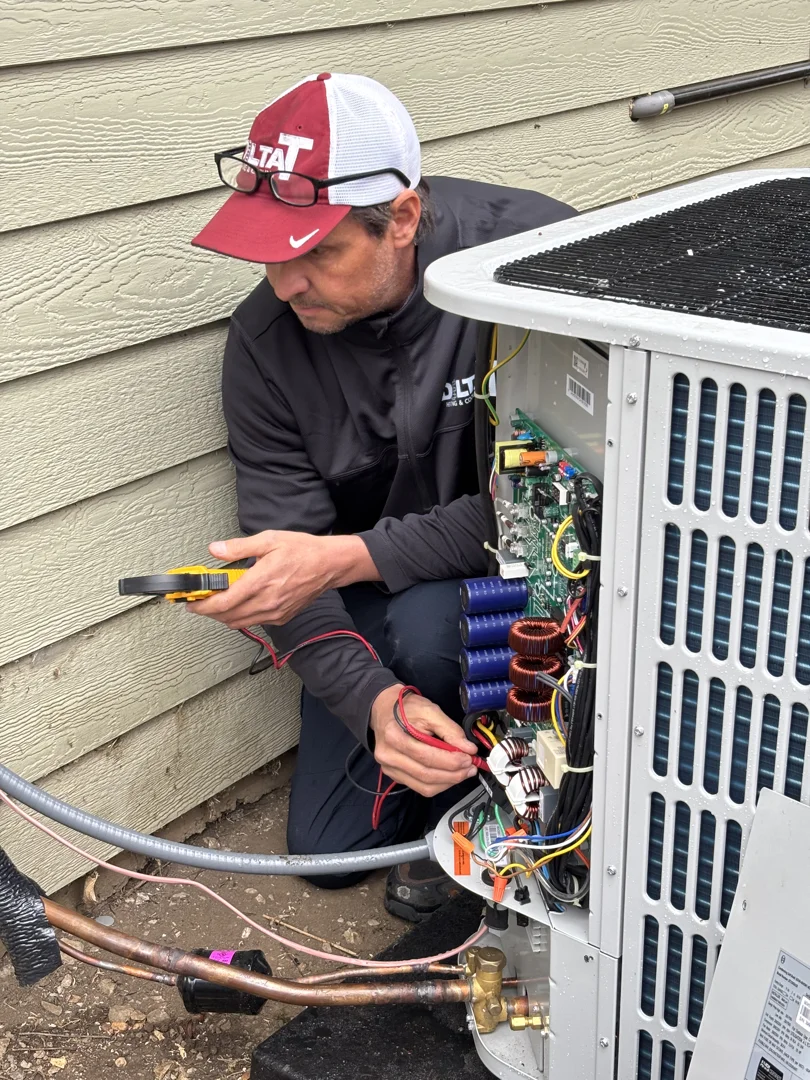
Beyond system age, another highly reliable framework is evaluating the severity of the component failure. If a single repair requires replacing a primary, high-value component on an older system, choosing to replace the entire unit is almost always the more practical choice.
Major component failures are the most common triggers for replacement. The compressor is the heart of your air conditioner; if it fails on a system that is out of warranty, the labor and parts required to swap it out are substantial. Similarly, an evaporator coil leak or a failed blower motor on an older furnace can represent a massive hurdle.
To help you visualize where your system currently stands, we have compiled a direct comparison of repair versus replacement indicators:
| Repair Indicators | Replacement Indicators |
|---|---|
| System is under 10 years old | System is over 12–15 years old |
| Unit is still protected under manufacturer warranty | Warranty has expired, leaving you responsible for all parts and labor |
| Minor component failure (capacitor, contactor, flame sensor) | Major component failure (compressor, heat exchanger, coil) |
| Utility bills remain stable and consistent | Monthly energy bills are steadily climbing |
| Consistent, even temperatures throughout the home | Noticeable hot and cold spots or poor humidity control |
| System uses modern, widely available refrigerant | System runs on obsolete, hard-to-source R-22 refrigerant |
Environmental and Regulatory Factors in 2026
The year 2026 marks a massive turning point for the heating and cooling industry, and these environmental regulations should heavily weigh on your decision to repair or replace.
The biggest headline is the ongoing phase-down of older refrigerants. If you have an older air conditioner manufactured before 2010, there is a very high probability that it utilizes R-22 refrigerant (commonly known as Freon). The production and import of R-22 was completely banned in the United States, meaning any repairs requiring a refrigerant recharge must rely on dwindling, reclaimed stockpiles. This has driven the availability of R-22 down, making even a minor leak repair highly impractical.
Even if your system uses R-410A, the industry standard for the last fifteen years, you are now seeing the effects of the EPA's phased transition to lower-GWP (Global Warming Potential) A2L refrigerants (such as R-454B and R-32), which became mandatory for new equipment manufacturing. While R-410A systems remain completely legal to own and service, the phase-down of R-410A production means leak repairs and recharges will steadily become more difficult and resource-intensive to perform over the next few years.
If your older system has a significant refrigerant leak, investing in a recharge is often a temporary fix that may not be sustainable in the long run.
Energy Efficiency and Long-Term Utility Savings
When homeowners look at upgrading their HVAC system, they often overlook the ongoing energy drain of keeping an inefficient older unit running. An older system doesn't just require more frequent attention; it consumes significantly more energy every single hour it runs.
HVAC efficiency has leaped forward over the last decade. Modern air conditioners are rated using SEER2 (Seasonal Energy Efficiency Ratio 2), furnaces are measured by AFUE (Annual Fuel Utilization Efficiency), and heat pumps utilize HSPF2 (Heating Seasonal Performance Factor 2).
According to the Department of Energy, upgrading an outdated, standard-efficiency system to a modern, high-efficiency model can cut your monthly heating and cooling energy usage by 20% to 40%. If you choose an ENERGY STAR® certified system, you can achieve an additional 15% in annual energy savings.
For example, switching from an old SEER 9 air conditioner to a modern SEER2 14 or 16 system can reduce your cooling energy consumption by more than 35%. Over a five-to-ten-year period, these monthly utility savings can make a substantial difference in your overall household energy consumption.
Safety First: Non-Negotiable Replacement Triggers
While many HVAC decisions exist in a gray area, there are certain situations where safety concerns completely override all other factors. In these scenarios, replacement is the only responsible option.
The most critical safety hazard in a gas furnace is a cracked heat exchanger. The heat exchanger is the metal chamber that prevents toxic combustion byproducts—specifically carbon monoxide (CO)—from mixing with the clean air circulating through your home. If a heat exchanger develops even a hairline crack, it poses an immediate, life-threatening carbon monoxide poisoning risk.
Because a cracked heat exchanger cannot be safely patched or repaired, and replacing the component out-of-warranty is incredibly labor-intensive, finding a crack almost always means it is time to shut down the system and install a new furnace immediately.
Other non-negotiable safety triggers include recurring gas leaks, severe electrical fire hazards within the cabinet, or major, unresolvable ventilation issues.
Frequently Asked Questions About HVAC Decisions
What rebates or incentives are available in 2026?
The year 2026 offers an incredibly favorable landscape for homeowners looking to upgrade their heating and cooling systems. While older federal tax programs have shifted, state-level rollouts of the Home Electrification and Appliance Rebates (HEAR) program can provide substantial savings for income-qualified households transitioning to high-efficiency heat pump technology.
Additionally, many local utility companies throughout the Kansas City metro area offer mail-in rebates for installing high-efficiency SEER2 air conditioners, heat pumps, and smart thermostats. When you pair these utility incentives with manufacturer promotions and flexible financing options, upgrading to a modern system becomes much more accessible than it might initially seem.
How does the local climate affect system lifespan?
Our local Midwest weather is notoriously tough on HVAC equipment. We experience extreme seasonal swings—sweltering, humid summer days followed by bitter, sub-zero winter temperatures.
Because our systems must run hard for both cooling and heating, they accumulate runtime hours much faster than units in milder climates. This intense wear and tear means that an air conditioner in our area may begin showing significant signs of decline around the 10-to-12-year mark, rather than lasting the full 15 years seen in other parts of the country.
How can I get an unbiased opinion on my system?
The best way to avoid high-pressure sales tactics is to work with an HVAC provider that specializes in both repairs and replacements. If a company only does installations, they will naturally push you to replace; if they only do basic service, they might encourage you to keep patching an unsafe system.
When a technician inspects your unit, ask them to show you the physical evidence of their diagnosis. A trustworthy technician will gladly show you manifold pressure readings, electrical multimeter numbers, or borescope photos of your heat exchanger.
Conclusion
Deciding whether to repair or replace your heating and cooling system doesn't have to be a stressful guessing game. By evaluating your system's age, tracking repair frequency, and factoring in modern efficiency savings, you can make a choice that protects both your home comfort and your long-term peace of mind.
At Delta T Heating & Cooling, we are proud to provide prompt, honest, and professional service across Johnson County and the surrounding Kansas City metro area—including Overland Park, Olathe, Shawnee, Lenexa, and Leawood. We pride ourselves on delivering clear, detailed explanations so you always understand your options, and we offer comprehensive maintenance plans to keep your equipment running smoothly for years to come.
Whether you need a quick, reliable repair to get you through the season or a professional installation of a high-efficiency system, our team is here to help. Schedule professional AC service with Delta T Heating & Cooling today, and let us bring reliable comfort back to your home.
Talk to us
Need Help?
Engineer-led diagnosis. Upfront pricing. Free second opinions on outside quotes.
More Articles
View All PostsReady to Get Started?
Whether you need a repair, maintenance, or a new installation, our expert team is here to help.