ERV vs HRV: Which Is Right for Your Home?
When it comes to erv vs hrv which is right for your home, the short answer depends on your climate, your home's age, and how much moisture your household generates.
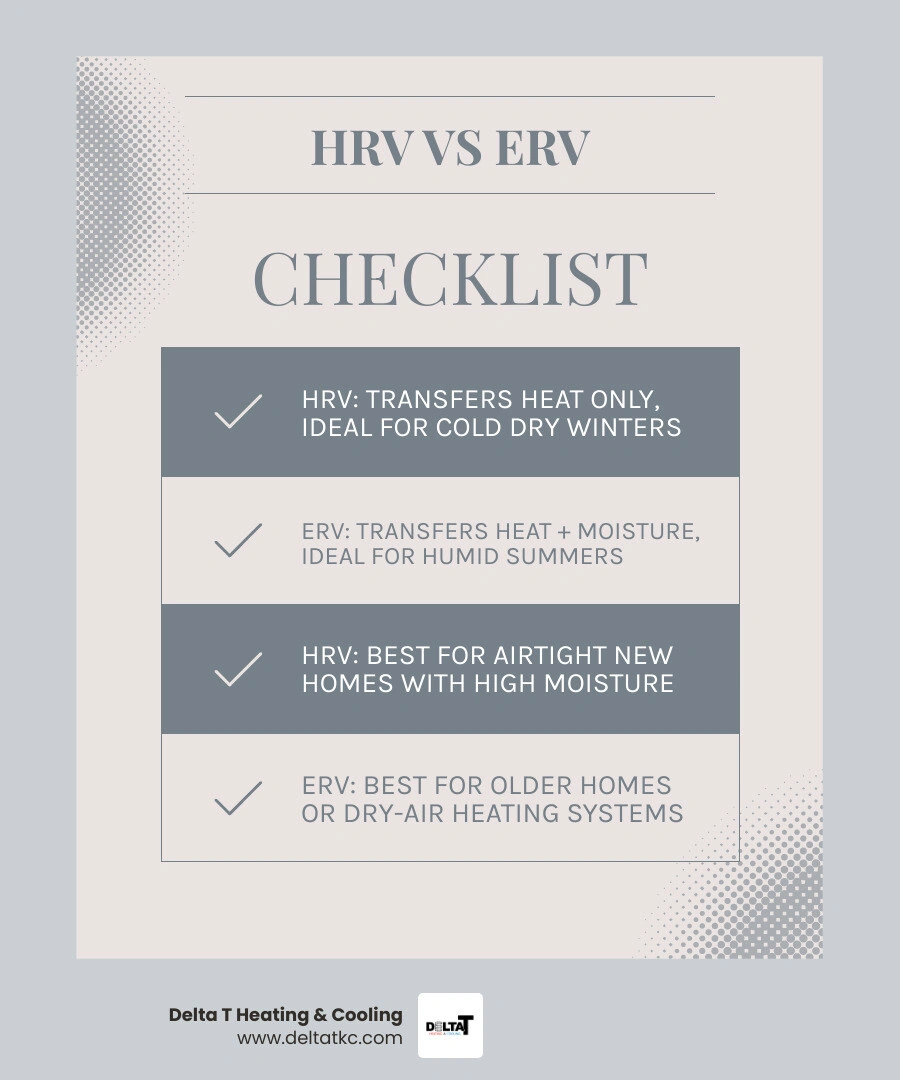
Here's a quick breakdown to help you decide:
| Factor | Choose an HRV | Choose an ERV |
|---|
| Climate | Cold, dry winters | Hot, humid summers or mixed climate |
| Home type | Newer, airtight construction | Older home or dry-air heating system |
| Humidity | Home feels damp or has window condensation | Home feels dry or stuffy |
| Household size | Larger household (more people = more moisture) | Smaller household generating less indoor humidity |
| Primary goal | Remove excess indoor moisture while saving heat | Balance both heat and humidity year-round |
Both systems do the same core job: they bring fresh outdoor air into your home while pushing stale indoor air out — without wasting the energy already used to heat or cool that air. The key difference is that an HRV transfers heat only, while an ERV transfers both heat and moisture.
For homeowners in Johnson County, where summers get humid and winters can be cold and dry, that distinction really matters.
Understanding Balanced Ventilation: How HRVs and ERVs Work
To understand why these systems are so revolutionary, we first have to look at how homes have changed over the years. Decades ago, homes were naturally "drafty." While this was terrible for energy efficiency, it meant that fresh air was constantly leaking in through cracks in windows, doors, and floorboards.
Today, we build and remodel homes to be incredibly airtight. This is fantastic for keeping your conditioned air inside, but it creates a major challenge: it traps stale air, cooking odors, pet dander, volatile organic compounds (VOCs), and moisture inside your living spaces.
Some homeowners rely on exhaust-only ventilation, like bathroom fans or kitchen range hoods. However, these systems create negative pressure inside the house. When you force air out of a sealed home, replacement air has to come from somewhere. It ends up pulling unconditioned, unfiltered air through random cracks in your crawlspace, attic, or walls.
Both Heat Recovery Ventilators (HRVs) and Energy Recovery Ventilators (ERVs) provide what we call "balanced ventilation." They use two fans: one to exhaust stale indoor air and another to bring in fresh outdoor air. Because the incoming and outgoing airflows are perfectly matched, your home stays balanced, with no negative or positive pressure issues.
The magic happens inside the heat exchanger core. The two air streams pass right next to each other in separate channels. They never actually mix, so the pollutants from your indoor air are safely exhausted outside. However, as they pass, thermal energy is transferred between them.
When discussing this energy transfer, HVAC professionals look at two types of heat:
- Sensible heat: This is the actual temperature of the air that you can read on a thermometer.
- Latent heat: This is the moisture or humidity held within the air.
Understanding the importance of proper ventilation is the first step toward a healthier home. By utilizing how ERV and HRV systems work, you can enjoy fresh air year-round without forcing your heating and cooling systems to work overtime.
What is a Heat Recovery Ventilator (HRV)?
An HRV is designed to transfer sensible heat only. During a cold winter day in Olathe or Leawood, your home's indoor air is warm and cozy, while the outdoor air is freezing. As the HRV exhausts the warm, stale indoor air, it passes through the heat-exchange core. At the exact same time, cold, fresh outdoor air is drawn in.
As these two air streams cross paths inside the core, the heat from the outgoing air is transferred to the incoming cold air. This pre-warms the fresh air before it ever reaches your living spaces or your furnace. In fact, high-quality HRVs can recover 70% to 95% of the sensible heat from the exhaust air.
In the summer, the process reverses. The cool indoor air absorbs heat from the hot incoming outdoor air, pre-cooling the fresh air before it enters your home. This drastically reduces the workload on your air conditioner.
Because an HRV only transfers heat and does not transfer moisture, it is highly effective at drying out a home. During the winter, indoor activities like showering, cooking, and doing laundry can cause humidity to build up inside a tightly sealed home. This often shows up as condensation on your windows, which can eventually lead to mold growth. An HRV solves this by continuously exhausting that damp indoor air and replacing it with dry, fresh outdoor air.
If you are looking to maximize your system's performance, focusing on improving HRV efficiency through proper duct design and seasonal calibration is key.
What is an Energy Recovery Ventilator (ERV)?
An ERV takes the ventilation process a step further. Instead of just transferring sensible heat, an ERV also manages latent heat (moisture).
Inside an ERV, the core is constructed from a specialized, semi-permeable membrane. This membrane allows moisture molecules to pass from the more humid air stream to the drier air stream, while keeping the actual air currents completely separate.
How does this work in the real world?
- In the summer: The outdoor air in the Kansas City metro can be incredibly muggy. An ERV draws in this hot, humid fresh air. As it passes through the membrane core, the system transfers both heat and moisture from the incoming fresh air to the cool, dry exhaust air. This means the fresh air entering your home is pre-cooled and pre-dehumidified. ERVs typically achieve 60% to 85% total energy recovery, including this crucial moisture transfer.
- In the winter: The air outside is cold and dry. Running your heating system can make your indoor air feel like a desert, leading to dry skin and sore throats. An ERV captures some of the moisture from your outgoing indoor air and transfers it to the dry incoming outdoor air, keeping your home at a much more comfortable humidity level.
By keeping excess moisture out in the summer and retaining comfortable humidity in the winter, you are enhancing comfort with ERV technology in a way that standard ventilation simply cannot match.
ERV vs HRV: Which Is Right for Your Home?
Choosing between these two systems requires looking at several home-specific details. While the quick-reference table in our introduction gives a great baseline, we need to dive deeper into how climate, home age, and construction styles interact with these systems.
To make the right choice, homeowners should look at matching systems to climate needs while considering how their specific household functions. Let's break down the two most critical deciding factors: climate and home construction.
Climate Factors: ERV vs HRV: Which Is Right for Your Home?
Our local weather patterns play a massive role in this decision. In Johnson County, we experience the full force of all four seasons. We have freezing, dry winters followed by hot, muggy summers.
Because we live in a mixed climate, the choice isn't always black and white.
- The Humid Summer Challenge: During July and August, outdoor relative humidity levels in areas like Overland Park and Shawnee can easily climb past 70% or 80%. If you run an HRV during these months, you will bring that heavy, humid air directly into your home, forcing your air conditioner or dehumidifier to work much harder to pull the moisture out. An ERV, on the other hand, can reduce the cooling system's latent load by approximately 30% in humid climates, keeping your air conditioner running efficiently and saving you from that sticky indoor feeling.
- The Dry Winter Challenge: In the dead of winter, outdoor air is notoriously dry. If your home has a forced-air furnace that already dries out the air, an HRV will exhaust your valuable indoor humidity, making the indoor air even drier. An ERV helps retain that indoor moisture, protecting your family from dry skin, static electricity, and respiratory irritation.
Understanding how Kansas City climate affects HVAC operations is essential when deciding which system will deliver the best year-round comfort.
Home Construction: ERV vs HRV: Which Is Right for Your Home?
The age and construction style of your home are just as important as the weather outside.
In newer, high-performance homes (especially those built after 2010 with tight building envelopes), indoor humidity can build up very quickly. A family of four produces roughly 3 to 4 gallons of water vapor every single day simply through breathing, cooking, and showering. In these highly sealed homes, an HRV is often the ideal choice because it helps flush out that excess moisture during the cold winter months, preventing condensation from forming on your windows.
If you are planning a new build or a major renovation, exploring specialized ERV designs for new homes can help you integrate balanced ventilation seamlessly into your structural plans from day one.
Key Factors to Consider When Choosing Your Ventilation System
Beyond climate and construction, several practical household details will influence your final decision:
- Household Size and Occupancy: The number of people (and pets!) living in your home directly impacts your indoor humidity. A large family in a compact, airtight home will generate a massive amount of moisture. In this scenario, an HRV is excellent for keeping indoor humidity levels under control. Conversely, a single occupant or a retired couple in a large home might struggle with dry air in the winter, making an ERV the superior choice to retain precious moisture.
- Type of Heating System: If your home uses a traditional gas furnace, the air can get incredibly dry in the winter. An ERV is highly recommended here to prevent over-drying. However, if you have hydronic radiant floor heating, your home naturally retains more moisture, making an HRV a great partner to keep the air fresh without over-saturating the space.
- Ductless vs. Whole-Home Options:
- Whole-Home Systems: These are integrated directly into your central HVAC ductwork or installed with their own dedicated run of ducts. They provide balanced ventilation to every room in the house, making them the gold standard for overall indoor air quality.
- Ductless Systems: If you have an older home in Lenexa or Mission without existing ductwork, or if you are ventilating a single problem area like a basement or a new home addition, ductless ERVs are a fantastic alternative. These compact units are installed directly through an exterior wall, providing localized fresh air without the need for extensive duct remodeling.
To ensure your system performs at its peak, sizing HVAC systems properly is absolutely critical. An undersized ventilator won't provide enough fresh air, while an oversized unit can waste energy and make it difficult to control indoor humidity.
Maintenance and Efficiency of Recovery Ventilators
Both HRVs and ERVs are highly energy-efficient additions to your home, but they do require some regular attention to keep running smoothly. Improperly installed or poorly maintained systems can lose 20% to 40% of their effectiveness due to dirty filters, leaky ductwork, or incorrect balancing.
To keep your system operating at peak efficiency, follow this simple maintenance checklist:
- Check and Clean Filters (Every 3 Months): Your ventilator has filters designed to capture dust, pollen, and outdoor allergens before they enter your home. Most systems utilize MERV 13 filtration. These filters should be checked every three months and cleaned or replaced depending on your local air quality.
- Inspect and Clean the Core (Annually): The heat-exchange core is the heart of your system. Once a year, you should slide the core out to inspect it. HRV cores can usually be washed with soap and water, while ERV cores should be vacuumed gently to avoid damaging the specialized moisture-permeable membrane. Always consult your manufacturer's guide for specific cleaning instructions.
- Check the Condensate Drain (Seasonally): Because HRVs (and some ERVs in extreme cold) remove moisture from the air, they generate condensation. This water is collected in a drain pan and directed out through a drain line. Ensure this line is clear of debris to prevent water backups.
- Inspect Exterior Hoods (Bi-Annually): Walk outside and check your fresh air intake and exhaust hoods. Ensure they are free from leaves, bird nests, or spiderwebs. The intake hood should always be located at least six feet away from any exhaust source (like your dryer vent or bathroom exhaust) to prevent cross-contamination.
For homes struggling with extreme summer humidity, integrating whole-house dehumidifiers alongside your ventilation system can provide the ultimate level of indoor comfort. To learn more about selecting and maintaining these systems, you can also browse this comprehensive choosing the right ventilation guide.
Frequently Asked Questions About Home Ventilation
Can an ERV or HRV replace my bathroom exhaust fans?
In most cases, no. Bathroom exhaust fans are designed for "spot ventilation" — meaning they quickly exhaust a large volume of highly concentrated moisture and odors directly from the source.
While an HRV or ERV can certainly supplement your bathroom ventilation by continuously drawing air from wet areas, local building codes usually still require dedicated spot exhaust fans in bathrooms and kitchens.
Do these ventilation systems run continuously?
They can, and many are designed to do so! Running your system on a continuous low-speed setting ensures a steady, uninterrupted supply of fresh, filtered air.
However, modern systems also come with smart controls. You can set them to run on a timer, operate only when your heating or cooling system is running, or automatically boost to a higher speed when indoor humidity levels spike (such as during morning showers).
How long do ERV and HRV systems typically last?
With routine maintenance and regular filter changes, a high-quality HRV or ERV system typically lasts between 15 to 20 years. Because the system utilizes simple, durable components — primarily a static heat-exchange core and reliable fan motors — they are incredibly long-lasting and dependable.
Conclusion
Finding the perfect balance of fresh air, comfortable humidity, and energy efficiency doesn't have to be a guessing game. Whether an HRV or an ERV is the ideal match for your home, investing in balanced mechanical ventilation is one of the best steps you can take for your family's health and comfort.
At Delta T Heating & Cooling, we are proud to serve homeowners across Johnson County and the surrounding Kansas City metro area. Our team of friendly, experienced professionals is dedicated to providing prompt, honest, and affordable service with detailed explanations every step of the way.
If you are ready to transform your indoor air quality and enjoy fresh, clean air year-round, schedule ventilation services in Kansas City with us today! We will help you assess your home's unique needs and install the perfect system for your lifestyle.


.webp)