Furnace Repair vs Replacement: When to Decide Smartly
Delta T Heating & Cooling
Learn when to decide on furnace repair vs replacement with our expert guide on system age, safety hazards, and cost-saving tips.
Is It Time to Fix or Replace Your Furnace? Here's How to Decide Fast
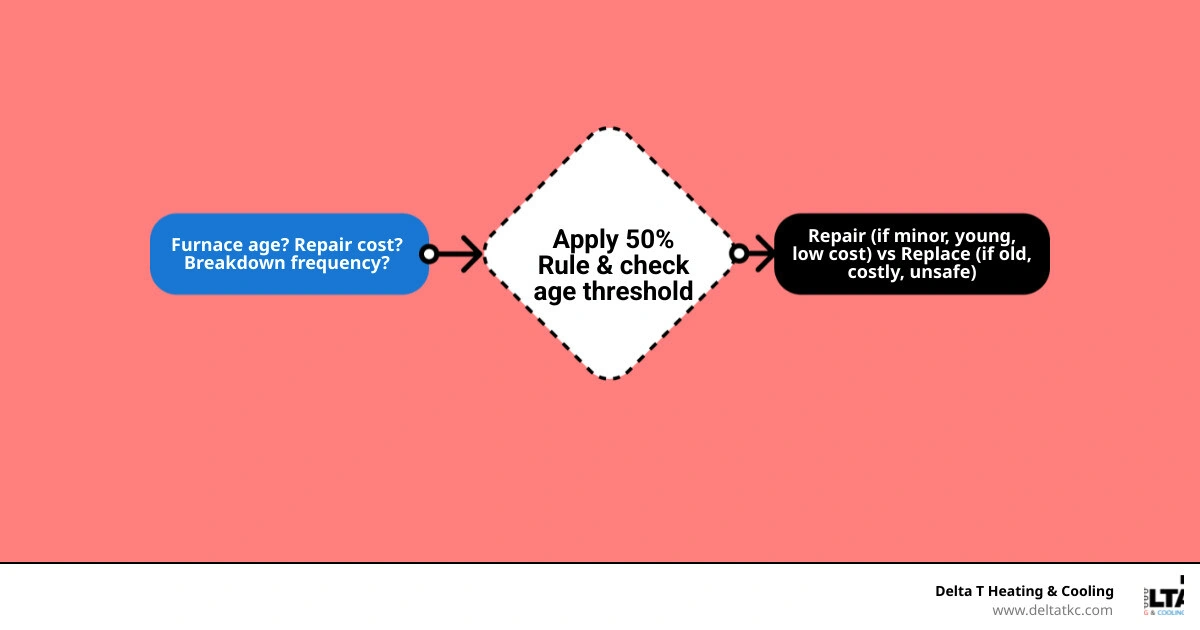
Knowing when furnace repair vs replacement when to decide comes down to three key factors: how old your system is, what the repair costs, and how often it breaks down. Here's a quick answer:
Repair your furnace if:
- It is under 12 years old
- The repair costs less than 50% of a new system's price
- The issue is minor (thermostat, flame sensor, clogged filter)
- It is still under manufacturer's warranty
Replace your furnace if:
- It is 15 years old or older
- The repair costs 50% or more of a new unit's price
- You have had multiple breakdowns in a single heating season
- There is a cracked heat exchanger or carbon monoxide risk
- Your energy bills keep climbing despite normal usage
Most furnaces last between 15 and 20 years. But when an aging system starts breaking down in the middle of a Johnson County winter, the pressure to make a fast decision can be overwhelming. The wrong call — patching a furnace that's on its last legs, or replacing one that had years of life left — can cost you hundreds or even thousands of dollars.
The good news? This decision doesn't have to be a guessing game. A few clear rules and warning signs make the choice much simpler than most homeowners expect.
Furnace Repair vs Replacement: When to Decide Based on System Age
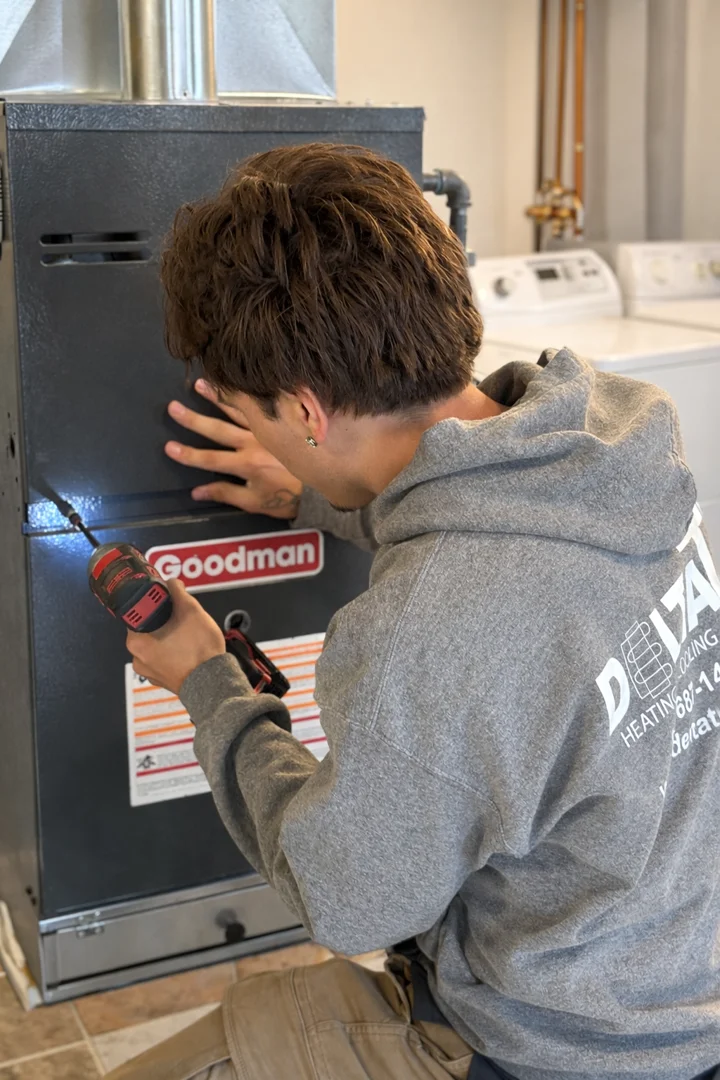
When we evaluate a heating system, age is always our starting point. Like any hard-working mechanical system, a furnace undergoes natural wear and tear that accelerates as the years tick by. While proper maintenance can help stretch your system's life, time always wins in the end.
A standard gas furnace typically has an operational lifespan of 15 to 20 years. Electric furnaces can sometimes last slightly longer, occasionally reaching 20 to 30 years because they have fewer moving parts and do not experience combustion wear. However, in our local climate — where freezing winter nights require our heating systems to run almost continuously for months on end — gas furnaces often begin to show significant degradation after 12 to 15 years of service.
As a furnace crosses the decade mark, its internal components become more brittle, its heat exchanger experiences continuous thermal expansion and contraction, and its overall heating efficiency begins to decline. If your system is still in its single digits, opting for a repair is almost always the smarter, more economical choice. Once the system passes 12 to 15 years of age, we must look closely at how the cost of any needed repairs compares to the value of a brand-new, high-efficiency system.
To help navigate these age-related milestones, you can read more about When to Repair and When to Replace a Furnace to see how timing plays a role in your comfort.
Applying the 50% Rule for Furnace Repair vs Replacement When to Decide
When you are faced with a sudden breakdown, the "50% Rule" serves as an excellent financial compass. This rule is a standard industry benchmark that removes the emotion from the decision-making process.
The application is simple: if the estimated cost of repairing your current furnace is 50% or more of the price of a brand-new system, you should replace the unit instead of repairing it.
Paying for an expensive repair on an older system that is already approaching the end of its natural lifespan is often a short-sighted financial move. You might fix the immediate issue today, only to have a completely different, expensive component fail next month. By applying this financial threshold, you protect yourself from pouring money into a failing asset and redirect those funds toward a reliable, modern heating system. For a deeper look at balancing these financial equations, check out our guide on How to Decide Between Repair and Replacement.
Using the Rule of 5,000 for Furnace Repair vs Replacement When to Decide
Another highly reliable mathematical tool we use to guide homeowners is the "Rule of 5,000." This formula takes both the age of your heating system and the cost of the proposed repair into account to give you a clear, objective recommendation.
To use the Rule of 5,000, simply multiply the age of your furnace (in years) by the estimated cost of the repair:
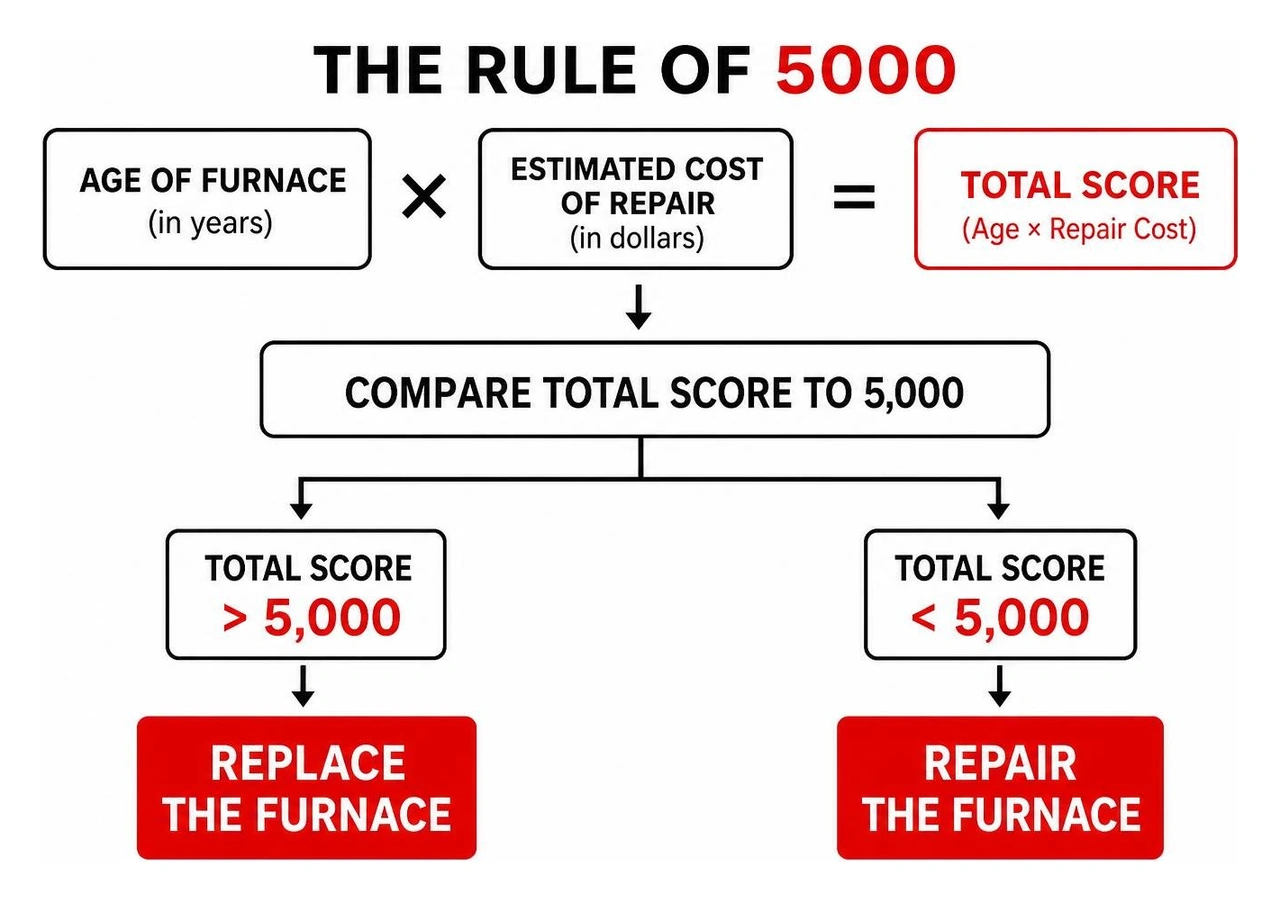
If the resulting number is greater than 5,000, we recommend replacing the furnace. If the number is less than 5,000, repairing the system is typically the more logical and cost-effective choice.
For example:
- Scenario A: You have an 8-year-old furnace that needs a moderate repair. Multiplying the age (8) by the repair factor yields a score well under the 5,000 threshold. In this case, repairing the unit is a safe, smart investment that allows you to get several more years of reliable service out of your system.
- Scenario B: You have a 15-year-old furnace facing that same repair. Multiplying the age (15) by the repair factor easily pushes your score past 5,000. Even though the repair itself isn't catastrophic, the advanced age of the system makes replacement the better long-term financial decision.
By using this calculation, you can make an objective decision based on the true value of your equipment. To learn more about how this formula fits into your overall home comfort strategy, read about When to Repair vs. Replace Your HVAC System.
Critical Warning Signs Your Heating System is Failing
Your furnace will rarely fail completely without giving you a few warning signs first. Recognizing these indicators early can save you from a middle-of-the-night emergency during a freezing winter cold snap.
Here are the most common signs that your heating system is experiencing severe mechanical decline:
- Frequent Short Cycling: If your furnace constantly turns on and off in rapid succession without ever truly warming your home, it is experiencing significant strain. This can be caused by failing sensors, a failing blower motor, or overheating.
- Strange and Unusual Noises: While no furnace is completely silent, loud banging, rattling, squealing, or clanking sounds are clear indicators of mechanical trouble. These sounds often point to loose components, failing bearings, or a damaged blower wheel.
- Uneven Heating and Cold Spots: If some rooms in your home feel like an icebox while others are uncomfortably warm, your furnace is struggling to distribute heat evenly. This can point to a failing blower motor or a cracked heat exchanger.
- Yellow or Flickering Burner Flame: A healthy gas furnace should always burn a steady, bright blue flame. A yellow, dancing, or flickering flame is a major warning sign. It indicates incomplete combustion, which can lead to the production of dangerous carbon monoxide.
If you notice any of these symptoms in your home, it is time to take action. Read our expert breakdown of the 5 Signs You Need a Furnace Replacement to see if your system is trying to tell you its time is up.
Safety Hazards That Mandate Immediate Replacement
While some furnace issues simply affect your comfort, others pose direct threats to your family's safety. When a major safety hazard is discovered, the debate between repair and replacement is over — replacement becomes an immediate, non-negotiable necessity.
The most critical safety concern in any gas furnace is a cracked heat exchanger. The heat exchanger is the metal chamber that contains the toxic combustion gases produced by the burner. It prevents these hazardous gases — including carbon monoxide — from mixing with the clean air that is circulated throughout your living spaces.
Over years of constant heating and cooling, the metal of the heat exchanger can crack or corrode. If this occurs, highly toxic, odorless, and colorless carbon monoxide gas can leak directly into your home's airflow. If an HVAC technician or gas utility provider discovers a cracked heat exchanger, they are legally required to "red tag" the system, shutting off the gas supply immediately to prevent a life-threatening situation.
Because replacing a heat exchanger is incredibly labor-intensive and requires replacing the core of the system, it is rarely logical to perform this repair on an older system. For your safety, a cracked heat exchanger on an out-of-warranty unit always warrants immediate replacement. To understand more about these critical safety protocols, you can read about When to Consider Furnace Replacement.
Performance Issues and Rising Utility Bills
Even if your furnace is not presenting an immediate safety hazard, a steady decline in performance can quietly drain your household budget.
Older furnaces lose their heating efficiency over time due to soot buildup, worn-out motors, and general mechanical wear. This efficiency loss is reflected in your system's Annual Fuel Utilization Efficiency (AFUE) rating. While modern high-efficiency condensing furnaces boast AFUE ratings of 90% to 98% (meaning only 2% to 10% of the energy spend is lost), older standard units may operate at ratings as low as 60% to 70%.
If you notice your monthly utility bills steadily climbing year after year despite your heating habits remaining the same, your furnace is likely working overtime just to maintain basic comfort. According to the U.S. Department of Energy, an inefficient, aging furnace can inflate your heating bills by up to 30 percent. Upgrading to a modern system can instantly lower your monthly energy consumption, helping the new unit pay for itself over time. To learn more about evaluating your system's performance, refer to our guide on How to Decide Between Repair and Replacement.
When Choosing Repair Makes the Most Sense
Despite the benefits of modern upgrades, we want to emphasize that replacement is not always the answer. In many cases, opting for a professional repair is the most practical and budget-friendly choice.
Repairing your furnace is highly recommended when:
- The System is Relatively New: If your furnace is under 10 to 12 years old, it still has plenty of operational life ahead of it. A professional repair can easily restore it to peak performance.
- The Issue is Minor and Isolated: Many common furnace issues are simple, wear-and-tear fixes. Replacing a faulty thermostat, cleaning a dirty flame sensor, replacing a worn igniter, or swapping out a clogged air filter are quick, affordable repairs that do not warrant replacing the entire system.
- The System is Still Under Warranty: Most major furnace manufacturers offer 5- to 10-year warranties on parts, and some offer up to 20-year coverage on the heat exchanger. If your system is still covered, the manufacturer will cover the cost of the replacement parts, making repair an incredibly cost-effective route.
- You Have a History of Regular Maintenance: If you have scheduled annual professional tune-ups, your system is likely in excellent overall health. A single component failure in a well-maintained system is usually an isolated incident rather than a sign of systemic collapse.
By prioritizing routine maintenance and addressing minor issues early, you can maximize your system's lifespan and delay the need for a full replacement. Explore your options further by reading our guide on Understanding Furnace Repair Options.
Long-Term Factors and Homeownership Plans
Your decision should also align with your long-term living and financial plans. If you plan to sell your home in the next year or two, investing in a complete heating system replacement may not allow you to fully recoup your investment through energy savings. However, keep in mind that an outdated, failing furnace is a massive red flag for potential home buyers, who may demand a steep price reduction or insist on a replacement before closing.
On the other hand, if you plan to stay in your home for the next 5 to 10 years or more, a proactive replacement is a fantastic investment. You will immediately benefit from lower monthly utility bills, superior indoor air quality, quieter operation, and the complete peace of mind that comes with a brand-new manufacturer's warranty. Additionally, modern high-efficiency systems often qualify for valuable local utility rebates and federal tax credits, helping to offset the upfront cost of your upgrade.
When planning a replacement, it is also highly beneficial to consider installing a "matched system." Replacing both your air conditioner and your furnace at the same time ensures perfect compatibility between the indoor blower motor and the outdoor cooling components, maximizing both airflow performance and overall system longevity.
| Factor | Furnace Repair | Furnace Replacement |
|---|---|---|
| Upfront Investment | Lower immediate cost | Higher initial investment |
| System Lifespan | Extends life of current unit temporarily | Provides 15–20 years of reliable heating |
| Monthly Utility Bills | Remains the same or continues to rise | Instantly lowers bills by up to 30% |
| Safety Assurance | Requires ongoing monitoring for hazards | Offers advanced, modern safety features |
| Warranty Coverage | Limited to the specific repaired part | Full manufacturer warranty on all components |
| Home Resale Value | Neutral impact (potential buyer red flag if old) | Significant selling point for home buyers |
To weigh these long-term benefits for your specific home, take a look at our detailed guide on When to Repair vs. Replace Your HVAC System.
Frequently Asked Questions About Furnace Decisions
How long does a typical gas furnace last in the Midwest?
In the Midwest, where winter demands are exceptionally harsh, a typical gas furnace lasts between 12 and 20 years. Because our systems must run continuously through extended subzero cold snaps, they accumulate mechanical wear much faster than systems in milder climates. Regular professional maintenance is key to helping your furnace reach the upper end of this lifespan.
Is it better to replace both the AC and furnace at the same time?
In many cases, yes. Replacing both units together creates a matched system, ensuring that the indoor furnace blower and the outdoor AC compressor are perfectly compatible. This maximizes energy efficiency, improves indoor airflow performance, and allows the installation team to complete both jobs in a single visit, saving you time and disruption.
What is the most critical safety issue in an older furnace?
The most critical safety concern is a cracked heat exchanger. Because this component separates toxic combustion byproducts from the clean air circulating through your home, any physical crack or rust hole can allow deadly, odorless carbon monoxide gas to enter your living spaces. Regular professional flue inspections and functional carbon monoxide detectors are essential safety measures for any home with a gas furnace.
Conclusion
Deciding between furnace repair and replacement doesn't have to be a stressful ordeal. By evaluating your system's age, utilizing simple financial tools like the 50% rule, and watching for critical warning signs, you can make a smart, confident decision that protects both your family's comfort and your budget.
If you are still on the fence about the best path forward for your home, we are here to help. At Delta T Heating & Cooling, we provide prompt, honest, and professional HVAC services across Johnson County — including Overland Park, Shawnee, Olathe, Lenexa, Leawood, and Prairie Village. Our friendly, experienced team will perform a comprehensive assessment of your system, provide a detailed, transparent explanation of our findings, and help you choose the most sensible solution for your unique needs.
Don't wait for the next winter freeze to make the decision for you. Schedule expert HVAC services today and let us keep your home safe, warm, and comfortable all season long.
Talk to us
Need Help?
Engineer-led diagnosis. Upfront pricing. Free second opinions on outside quotes.
More Articles
View All PostsReady to Get Started?
Whether you need a repair, maintenance, or a new installation, our expert team is here to help.