Mold Prevention Tips for Kansas City Homeowners: Stop Spores
Delta T Heating & Cooling
Learn about mold prevention tips for the kansas city metro homeowners
Why Mold Prevention Is Critical for Kansas City Metro Homeowners
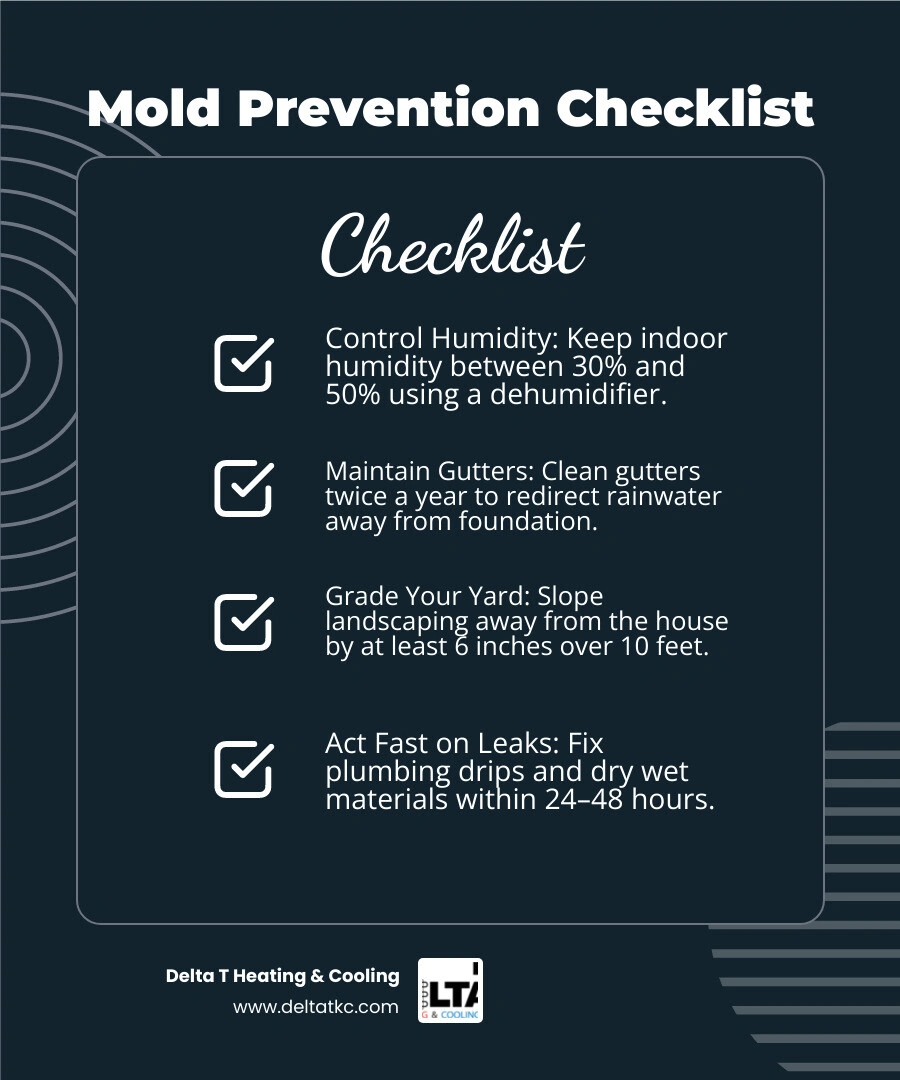
If you need mold prevention tips for the kansas city metro homeowners to protect your property, here is your quick action plan:
- Control Humidity: Keep indoor humidity levels strictly between 30% and 50% using a dehumidifier.
- Maintain Gutters: Clean your gutters twice a year to redirect rainwater away from your foundation.
- Grade Your Yard: Ensure your landscaping slopes away from the house by at least 6 inches over the first 10 feet.
- Ventilate Right: Run bathroom and kitchen exhaust fans during use and for 20 minutes afterward.
- Act Fast on Leaks: Fix plumbing drips immediately and dry any wet materials within 24 to 48 hours.
Living in the Midwest means dealing with heavy rain. Humid summers and sudden weather shifts can turn your basement into a breeding ground for mold. When damp air gets trapped inside your home, it causes musty smells. It can also damage your drywall and ruin wood framing. Our team at Delta T Heating & Cooling provides professional indoor air quality services in Kansas City, KS. We help you control moisture before it becomes a costly hazard. Managing your home's humidity is the best way to protect your property and keep your family breathing clean air year-round.
To keep your home dry and safe, explore our indoor air quality solutions or schedule a professional AC service in Kansas City today.
Mold prevention tips for the kansas city metro homeowners terms you need:
Why the Kansas City Metro is Prone to Mold
The Kansas City metropolitan area presents a unique set of geographic and environmental challenges that make residential mold growth a persistent threat. Spanning the state line from Wyandotte and Johnson counties in Kansas to Jackson and Clay counties in Missouri, our region features weather patterns and soil conditions that directly contribute to moisture accumulation inside homes.
One of the primary geological culprits is our heavy clay soil. Clay holds onto water far longer than sandy or loamy soils. When we experience heavy spring storms, this clay expands, creating immense hydrostatic pressure against basement walls. Over time, this pressure forces moisture through microscopic pores and cracks in concrete foundations—a process known as capillary action.
Additionally, local water bodies like the Missouri River and local streams like Brush Creek can overflow during severe weather events, raising the local water table and flooding low-lying residential areas in places like Riverside, Parkville, and parts of Kansas City, MO. This high water table guarantees that basement moisture remains a year-round battle.
Our climate is also highly variable. Kansas City experiences hot, humid summers and cold, dry winters, with rapid 40-degree temperature swings during the spring and fall shoulder seasons. In July and August, outdoor relative humidity routinely climbs above 70%. When this warm, wet air meets a cool basement floor or a poorly insulated wall, it condenses into water droplets, creating an immediate breeding ground for mold spores.
Furthermore, our local housing stock plays a major role. In the urban core of Kansas City, MO, the median housing construction year is 1969, with many historic homes in Midtown and Westport dating back even further. These older homes often feature aging limestone foundations, outdated uninsulated crawlspaces, and original plaster walls that hold onto moisture. Meanwhile, the suburban housing boom in Overland Park, Olathe, and Shawnee between the 1960s and 1980s means many homes are now dealing with deteriorating foundation waterproofing, failing sump pumps, and aging HVAC systems that struggle to manage humidity.
To understand the difference in environmental risks across the metro, let us look at the climate and mold risk profiles of our two largest communities:
| Climate & Housing Factor | Kansas City, MO Metro | Overland Park, KS |
|---|---|---|
| Average Annual Precipitation | 38.1 inches | 39.3 inches |
| Average Outdoor Humidity | 63% | 67% |
| Median Housing Year Built | 1969 | 1989 |
| Primary Soil Type | Heavy Clay | Expansive Clay |
| Major Local Moisture Drivers | River flooding, aging urban plumbing | Aging suburban storm sewers, finished basements |
| Peak Mold Risk Seasons | Spring (flooding), Summer (AC condensation) | Summer (high humidity), Winter (window condensation) |
Essential Mold Prevention Tips for Kansas City Metro Homeowners

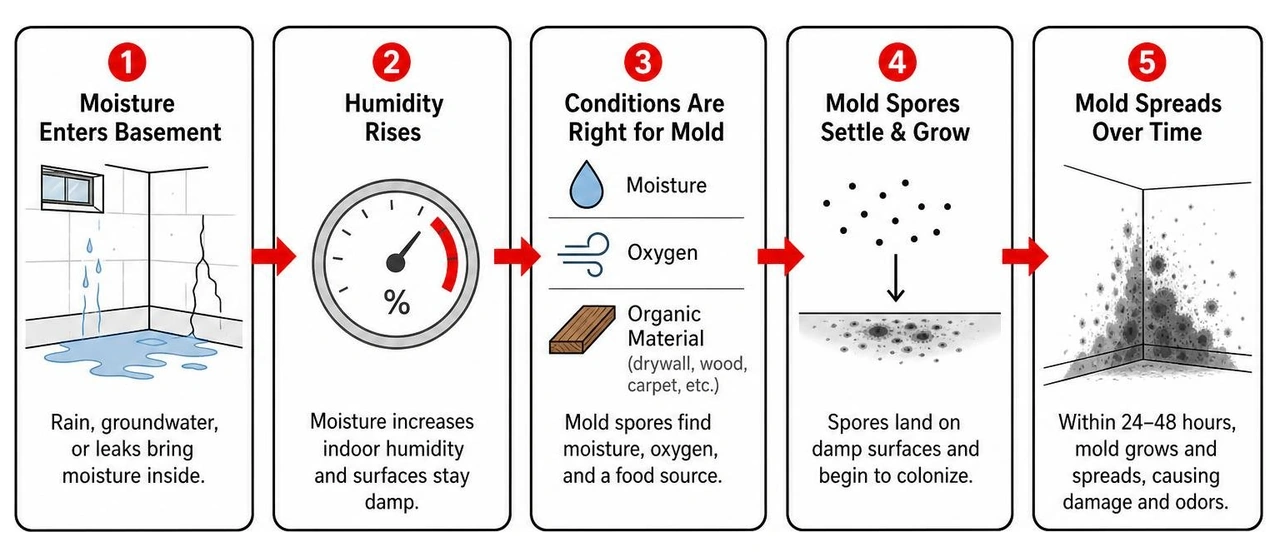
Understanding the science behind mold growth is your first step toward maintaining a healthy, comfortable home. Mold spores are microscopic organisms that exist naturally in both indoor and outdoor environments. They are completely harmless in low concentrations, but the moment they find a moisture source, oxygen, and an organic food source (such as drywall paper, wood framing, or carpet fibers), they begin to colonize.
According to the Centers for Disease Control and Prevention (CDC), mold can begin colonizing a damp surface in as little as 24 to 48 hours. This makes rapid moisture control your absolute first line of defense.
The gold standard for residential mold prevention is keeping your indoor relative humidity strictly between 30% and 50%. When humidity levels climb above 50%, mold spores find it much easier to settle and germinate. If your indoor air exceeds 60% humidity, mold will grow rapidly on drywall, wood joists, and even clothing stored in dark closets.
To manage this effectively, we recommend purchasing a digital hygrometer. This inexpensive device measures both temperature and relative humidity. Place hygrometers in high-risk areas of your home, such as the basement, crawlspace, utility room, or master bathroom, and monitor them weekly.
Using active moisture control strategies is essential to keeping these numbers in check. To find out more about the relationship between indoor air and structural protection, check out our guide on how humidity control prevents mold in your home.
Implementing Daily Mold Prevention Tips for Kansas City Metro Homeowners
Preventing mold does not always require major structural renovations. Integrating simple habits into your daily routine can drastically reduce moisture levels inside your living spaces:
- Ventilate Bathrooms and Kitchens: Always run your bathroom exhaust fans while showering and keep them running for at least 20 minutes after you finish. In the kitchen, turn on your range hood fan whenever you are boiling water or cooking to exhaust steam outdoors.
- Eliminate Window Condensation: During cold winter snaps in Leavenworth or Liberty, warm indoor air hitting cold glass pane surfaces causes "sweating" or condensation. Wipe down wet window sills immediately to prevent water from rotting the wooden frames.
- Dry Wet Materials Promptly: Never leave wet towels bunched up on the floor, and avoid hanging laundry to dry indoors on drying racks, which releases gallons of moisture directly into your air.
- Check for Hidden Signs: Use your nose as a diagnostic tool. If a room has a persistent "wet sock" or musty odor, or if you spot peeling paint and bubbling wallpaper, you likely have a hidden moisture problem behind the drywall.
Managing Basement and Crawlspace Moisture
Basements and crawlspaces are the most vulnerable areas for mold growth in the Kansas City metro. Because these spaces are completely or partially below-grade, they are surrounded by damp clay soils and are naturally cooler than the rest of the house, making condensation highly likely.
To protect your lower levels, implement these basement-specific moisture control strategies:
- Install and Maintain a Sump Pump: Your sump pump is your basement's primary defense against a rising water table. Test it twice a year by pouring a bucket of water into the pit to ensure the float switch activates.
- Add a Sump Pump Battery Backup: Severe spring thunderstorms in Lee's Summit and Olathe frequently knock out electrical power. A battery backup system ensures your sump pump continues to run even when the main power grid goes down.
- Encapsulate Your Crawlspace: If your home has a dirt crawlspace, moisture constantly evaporates out of the soil and rises into your floor joists. Encapsulating the space with a heavy-duty 20-mil plastic vapor barrier stops this moisture transmission in its tracks.
- Deploy a Dedicated Dehumidifier: Standard portable dehumidifiers from big-box stores often lack the capacity to dry out a damp Midwestern basement. Investing in a high-capacity, professional-grade basement dehumidifier with a continuous gravity drain hose ensures your lower level stays below the critical 50% humidity threshold.
The Role of Your HVAC System in Moisture Control
Many homeowners think of their heating and cooling system solely as a temperature controller, but your air conditioner is actually your home's primary dehumidifier. As warm, humid air is pulled across your AC system's cold evaporator coil, water vapor condenses out of the air and drips into a drain pan, lowering the humidity of the air returned to your living spaces.
However, your air conditioner can only dehumidify effectively if it is properly sized and maintained. In the HVAC industry, we balance two types of cooling loads:
- Sensible Load: The actual physical temperature drop you feel on your skin.
- Latent Load: The removal of moisture from the air.
On mild but highly humid spring days in Lenexa or Gladstone (for example, a 74-degree day with 85% outdoor humidity), an oversized air conditioner will cool your home down to your thermostat's setpoint incredibly fast. This is known as short-cycling. Because the system only runs for 5 to 10 minutes at a time, it never runs long enough to pull latent moisture out of the air. You are left with a home that feels cool, clammy, and stuffy—the perfect environment for mold to take root.
To prevent short-cycling and manage high humidity, we recommend upgrading to a variable-speed air handler. Unlike standard single-stage systems that blast on and off at 100% capacity, variable-speed systems run continuously at lower speeds, providing constant airflow and superior latent moisture removal.
To understand how high outdoor humidity impacts your cooling system's performance and energy efficiency, read our detailed article on how high humidity in the Kansas City area makes your AC work harder.
Additionally, you can install indoor air quality accessories directly into your ductwork to destroy mold spores before they can circulate. Integrating a UV-C germicidal light system next to your AC evaporator coil prevents mold from growing on the damp metal surfaces. Combining UV-C lights with high-efficiency MERV 11 to 13 air filters allows your system to capture and neutralize microscopic spores down to 3 microns in size.
How HVAC Maintenance Supports Mold Prevention Tips for Kansas City Metro Homeowners
Regular, professional maintenance is the single most important factor in keeping your HVAC system from becoming a source of mold itself. Because your air conditioner's evaporator coil is constantly damp during the cooling season, any dust or dirt that bypasses your air filter can settle on the wet metal and feed mold colonies inside your ductwork.
To keep your system running safely, focus on these critical maintenance tasks:
- Clear the Condensate Drain Line: The water pulled from your indoor air must drain safely outside. Algae and slime can easily clog your condensate line, causing water to back up and overflow into your furnace cabinet or onto your basement floor. Flush your drain line with a cup of plain white vinegar once a season to keep it clear.
- Change Filters Every 30 Days: A clogged air filter restricts airflow across your evaporator coil. This can cause the coil to freeze over, creating a massive puddle of water when it eventually thaws.
- Schedule Professional Coil Cleaning: Over time, fine dust particles build up on your evaporator coil, reducing heat transfer and creating an organic food source for mold. Our technicians use specialized, self-rinsing coil cleaners to keep these surfaces sterile.
- Install a Whole-House Dehumidifier: For complete humidity control, we can install a whole-house dehumidifier directly into your existing ductwork. These systems pull up to 120 pints of water per day from your air, operating independently of your air conditioner to keep your home in the "Goldilocks zone" of 30% to 50% humidity.
Explore how preventative maintenance keeps your air clean by reading how proper hvac maintenance prevents mold growth, and learn more about our local installation options for whole-house dehumidifiers in Kansas City, KS.
Exterior Defense: Gutters, Roofing, and Landscaping
To successfully prevent indoor mold, you must maintain a strong exterior envelope. If rainwater penetrates your siding, roof, or foundation, no amount of indoor ventilation or dehumidification will stop mold from growing inside your wall cavities.
To defend your home's exterior against the 38 to 50 inches of precipitation our region receives annually, prioritize these maintenance steps:
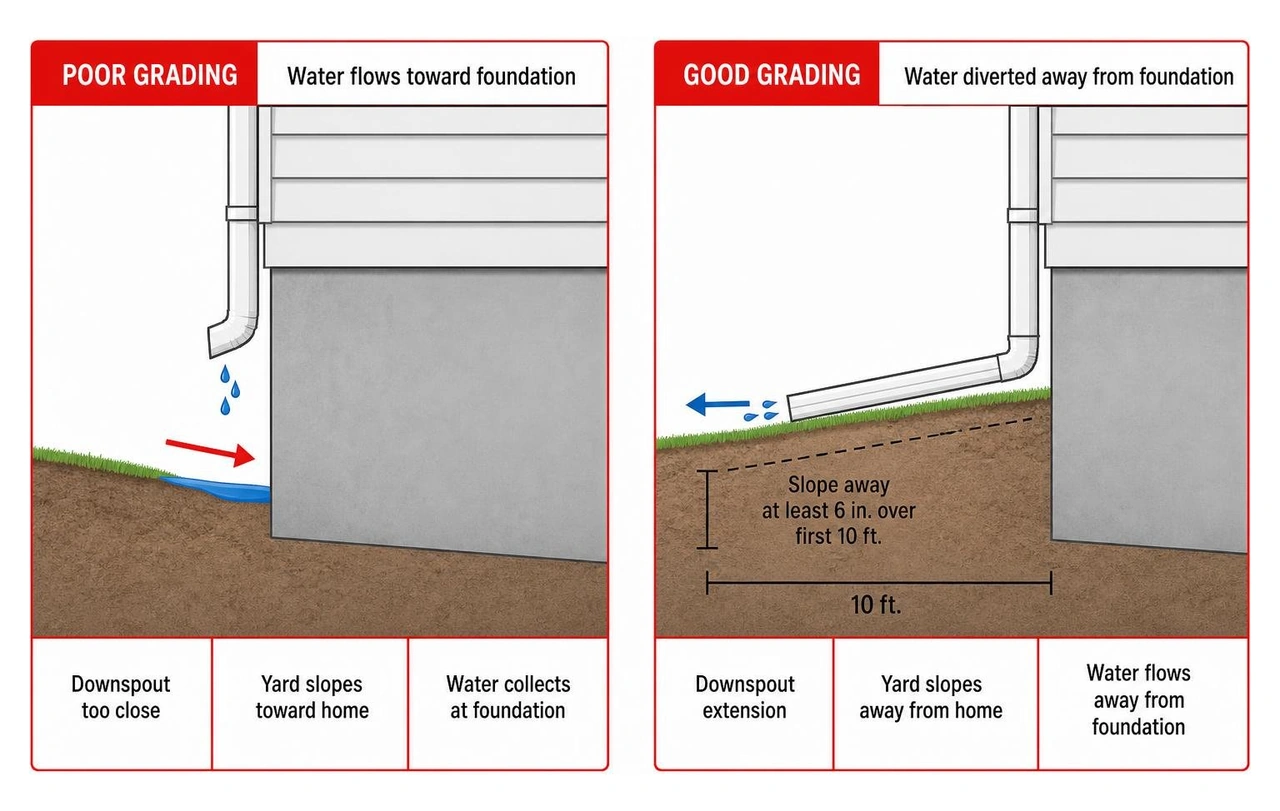
- Clean Gutters Twice a Year: Clogged gutters cause rainwater to overflow and pool directly next to your foundation. Clean your gutters in the spring and late fall, and ensure your downspout extensions direct water at least 5 to 6 feet away from your home's walls.
- Correct Your Yard's Grading: Your yard should slope away from your foundation by at least 6 inches over the first 10 feet. If your yard has settled or slopes toward your house, clay soils will trap water against your basement walls.
- Inspect Roof Flashing and Shingles: Roof leaks can travel down inside attic insulation and drywall for months before showing visible signs on your ceiling. Inspect your roof annually, paying close attention to the flashing around chimneys, vents, and valleys.
- Maintain Siding and Window Seals: Check fiber cement or vinyl siding for gaps, cracks, or warping. Ensure the caulking around windows and doors is fully intact to prevent rain from blowing behind your structural framing.
Frequently Asked Questions About Kansas City Mold Prevention
What should I do immediately after a leak or flood to prevent mold?
If you experience an appliance failure, a burst pipe, or heavy storm flooding, you must act within a strict 24 to 48-hour window to prevent mold spores from colonizing.
First, locate your main water shut-off valve and turn it off immediately to stop the source of the water. Next, document the damage with photos and contact a professional water extraction service to remove standing water. Use heavy-duty air movers and commercial-grade desiccant dehumidifiers to dry out the structural framing, subfloors, and drywall.
When should I call a professional for mold remediation?
If you discover mold in your home, the Environmental Protection Agency (EPA) recommends a simple rule of thumb: if the affected area is less than 10 square feet (roughly a 3-foot by 3-foot patch), you can typically handle the cleanup yourself using soap, water, and proper protective gear.
However, you should contact a certified mold remediation specialist immediately if:
- The mold covers an area larger than 10 square feet.
- The mold returns after repeated cleanings, indicating an unresolved moisture source.
- The mold is growing inside your HVAC ductwork or heating and cooling equipment.
- Family members are experiencing unexplained physical symptoms, such as persistent coughing, sneezing, headaches, or asthma flare-ups.
What are the legal rights of Kansas City tenants regarding mold?
If you are renting a home or apartment in the Kansas City metro, your legal rights depend on which side of the state line you reside on.
In Missouri, there are no explicit mold-specific statutes. However, state courts recognize an implied warranty of habitability. This legal principle requires landlords to maintain rental properties in a safe, sanitary, and livable condition. If a severe mold issue is caused by landlord neglect (such as an unaddressed roof leak or broken plumbing), the tenant may have legal grounds to break their lease or withhold rent under strict legal guidelines.
In Kansas, landlord-tenant relationships are governed by statute K.S.A. 58-2553. This law requires landlords to maintain all electrical, plumbing, sanitary, heating, and ventilating systems in safe and working order. If a tenant reports a moisture or mold issue in writing, the landlord generally has 14 days to initiate repairs.
Conclusion
Preventing mold in the Kansas City metro requires a proactive approach that combines exterior defense, daily moisture awareness, and active indoor humidity control. By keeping your indoor relative humidity strictly between 30% and 50%, maintaining your gutters, and ensuring proper ventilation, you can successfully stop mold spores in their tracks and protect your home's structural integrity.
At Delta T Heating & Cooling, we are proud to serve homeowners throughout Johnson County, including Overland Park, Olathe, Shawnee, Lenexa, and Leawood. We are committed to providing prompt, honest, and professional HVAC and indoor air quality services at affordable prices. Our certified technicians provide detailed explanations of your home's air quality needs and design customized maintenance plans to keep your systems running efficiently year-round.
If you want to upgrade your home's defenses, learn how whole house dehumidifiers prevent mold and explore our full range of advanced air purification services in Kansas City.
Ready to schedule your seasonal tune-up? Contact Delta T Heating & Cooling today for reliable, professional AC service in Kansas City!
Talk to us
Need Help?
Engineer-led diagnosis. Upfront pricing. Free second opinions on outside quotes.
More Articles
View All PostsReady to Get Started?
Whether you need a repair, maintenance, or a new installation, our expert team is here to help.