Is a 12 to 15 Year Old AC Worth Repairing in a Hot Kansas City Climate?
Is a 12 to 15 year old AC worth repairing in a hot Kansas City climate? Here's the short answer most homeowners need right now:
Quick Answer:
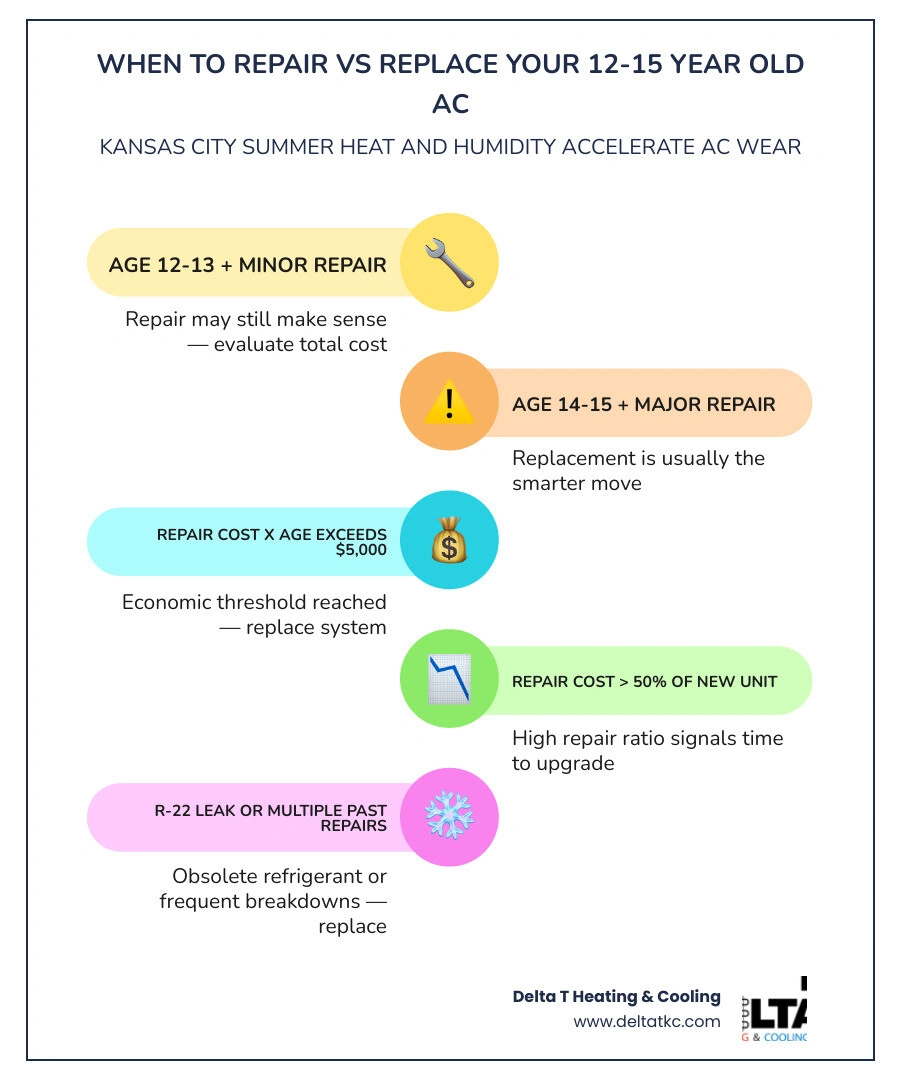
| Situation | Recommendation |
|---|
| Unit is 12-13 years old, minor repair needed | Repair may still make sense — evaluate cost |
| Unit is 14-15 years old, major repair needed | Replacement is usually the smarter move |
| Repair cost x unit age exceeds $5,000 | Replace the system |
| Repair cost exceeds 50% of new system cost | Replace the system |
| Unit uses R-22 refrigerant and has a leak | Replace — refrigerant is no longer produced |
| Multiple repairs in the past 2 years | Strong sign of systemic decline — replace |
Kansas City summers are no joke. Temperatures regularly hit 89°F, humidity pushes dewpoints into the 70s, and your air conditioner runs hard for months on end. That kind of workload accelerates wear on every major component — compressors, coils, capacitors, and refrigerant lines.
Most central AC systems are built to last 10 to 15 years. In Kansas City's climate, that upper end of the range is harder to reach than in cooler, drier parts of the country. So if your unit is already 12 to 15 years old, you're not just dealing with an aging system — you're dealing with one that has likely been working overtime every summer.
The repair-or-replace decision isn't always obvious. Age alone doesn't settle it. Neither does a single repair bill. What matters is the full picture: how often it breaks down, what type of refrigerant it uses, how efficiently it still cools your home, and whether the math actually favors keeping it alive.
This guide walks you through exactly how to make that call — with clear frameworks, local climate context, and honest guidance.
Is a 12 to 15 year old ac worth repairing in a hot kansas city climate terms to learn:
Understanding the Lifespan of Kansas City Air Conditioners
To understand if your air conditioner is worth saving, we first have to look at how the local climate treats mechanical equipment. Nationally, an air conditioner might enjoy a relatively peaceful life of 15 to 20 years in a temperate, dry region. But here in the Midwest, our weather is anything but temperate.
In Kansas City, our cooling systems are exposed to extreme environmental stressors that compress their natural lifespans down to the 10-to-15-year range. Here is why:
- Extreme Summer Heat and High Humidity: July and August bring relentless heat waves, with temperatures frequently soaring into the 90s (and sometimes triple digits). Combined with oppressive humidity, your AC must run longer, harder cycles to pull both heat and moisture out of your indoor air. This puts immense physical strain on the compressor and the fan motor.
- The "Clay Soil" Factor: If you live south of the Missouri River—in communities like Overland Park, Olathe, or Leawood—you are likely familiar with our heavy clay soil. This soil expands when wet and shrinks dramatically during dry summer spells. This constant shifting can cause outdoor condenser pads to tilt, putting physical tension on the copper refrigerant lines and leading to micro-leaks.
- Freeze-Thaw Cycles: Our winters are brutally cold, while our summers are hot. The transition periods in spring and autumn bring rapid freeze-thaw cycles. This constant expansion and contraction of metals creates micro-stresses on solder joints over a 12-to-15-year period, eventually leading to structural weaknesses.
Because of these unique environmental challenges, local air conditioners age faster than those in other parts of the country. For a deeper look into this phenomenon, read our article on Why AC Systems in the Kansas City Area Wear Out Faster Than the National Average.
Is a 12 to 15 Year Old AC Worth Repairing in a Hot Kansas City Climate?
When your air conditioner crosses the 12-year mark, it enters its twilight years. At this stage, every repair decision carries financial risk. You have to ask yourself: Are we fixing a temporary issue, or are we throwing money at a system in systemic decline?
To make an informed decision, we use a reliability framework that weighs the age of the unit, its current efficiency losses, and the frequency of your service calls.
If your air conditioner is 12 to 15 years old, it operates on older technology. Over its decade-plus of service, dirt buildup, minor electrical wear, and coil degradation have likely reduced its operating efficiency. A system that started as a 13 SEER unit might now be performing closer to an 8 or 9 SEER system, quietly driving up your summer energy bills even when it is "working."
If you find yourself calling an HVAC technician every summer just to get through July, you are on a "repair spiral." Repairing one isolated part—like a capacitor or a fan motor—does not restore the rest of the aging components. It simply keeps a vulnerable system running until the next weak link breaks under the weight of a Kansas City heatwave.
For guidance on navigating these tough choices, see our survival guide: Should I Repair or Replace My Air Conditioner in the Kansas City Area.
Sometimes, the decision isn't just about the mechanical parts; it is about how your home actually feels. An aging system nearing the end of its life will show clear performance warning signs:
- Uneven Cooling: Are some rooms ice-cold while your upstairs bedrooms feel like a sauna? Older systems struggle to distribute air evenly as blowers and compressors degrade.
- Constant Running: If your AC runs continuously without ever reaching the temperature set on your thermostat, it can no longer keep up with the outdoor heat load.
- Poor Humidity Control: A properly functioning AC acts as a dehumidifier. When it loses capacity, your home begins to feel sticky, clammy, and uncomfortable, even if the air is relatively cool.
- Weak Airflow: Dust buildup, failing blower motors, or collapsing ductwork insulation can restrict the volume of air circulating through your home.
If your home is exhibiting these comfort issues, it is a strong indicator that the system is failing to meet your daily needs. Learn more about identifying these issues in our guide to Signs Your AC Needs Repair.
The Impact of Obsolete R-22 Refrigerant on Older Units
If your air conditioner was installed more than 15 years ago (or even during the transition period around 12 to 15 years ago), there is a high probability it uses R-22 refrigerant, commonly known as Freon.
The U.S. Environmental Protection Agency (EPA) completely phased out the production and import of R-22. Because the supply is strictly limited to recycled and reclaimed quantities, servicing an R-22 system has become incredibly expensive.
If an older unit develops a refrigerant leak in the evaporator or condenser coils, simply finding and patching the leak—and then recharging the system with R-22—is rarely a wise investment. Furthermore, replacement parts for these legacy systems are becoming increasingly difficult to source, often leaving homeowners waiting days for critical components during the hottest weeks of summer.
Decision Frameworks for Aging AC Units
To remove emotion from the repair-versus-replace dilemma, we rely on two proven mathematical decision frameworks: the $5,000 Rule and the 50% Rule.
Let's look at how this math works in real life:
- Scenario A: You have a 13-year-old AC unit that needs a minor electrical repair (like a contactor or capacitor). The math: 13 years old multiplied by a relatively low repair cost yields a product well under 5,000. In this case, repairing the unit is a reasonable, low-risk option to buy yourself more time.
- Scenario B: You have a 14-year-old AC unit that has a failed compressor or a major coil leak. Multiplying 14 years by the high cost of a major component replacement yields a product far exceeding the 5,000 threshold. The math clearly indicates that investing in a replacement is the smarter financial move.
The 50% Rule is even simpler: if the cost of the proposed repair exceeds 50% of the value of a brand-new, modern air conditioning system, you should transition those funds directly toward a replacement.
To help you visualize these decision points, review this comparison table:
| System Age | Repair Frequency (Past 2 Years) | Recommended Action | Financial Justification |
|---|
| 12 Years | 0 - 1 minor repairs | Repair | The system still has some useful life; minor repairs keep it viable. |
| 12 Years | 2+ repairs or major leak | Replace | Multiple failures indicate systemic decline; R-22 systems should be retired. |
| 13-14 Years | Any major component failure | Replace | High risk of secondary failures; fails the $5,000 rule. |
| 15 Years+ | Any repair | Replace | The system has reached the end of its economic lifespan; modern upgrades offer immediate savings. |
For a step-by-step breakdown of how to apply these rules to your specific situation, check out our resource on How to Decide Between Repair and Replacement.
Evaluating the Age and Repair Frequency of Your Unit
If you find yourself on a first-name basis with your HVAC technician, your system is likely trying to tell you something. A single, isolated mechanical failure on a well-maintained 12-year-old unit is normal. However, three or more service calls over a two-year span point to a deeper issue.
As components age, they put additional stress on neighboring parts. A weak capacitor can cause the compressor to overheat, while a failing fan motor can cause pressures to spike throughout the system.
Continuing to make small repairs on a failing unit is like putting a new transmission into a high-mileage car with a rusted frame—it doesn't change the underlying reality that the system is reaching its limit. Read more about finding this limit in our guide: How Much AC Repair is Too Much Before Replacing Your Unit.
Applying the Lifespan Rule: When to Transition to a New System
There is a distinct difference between keeping an air conditioner running and maintaining a comfortable, efficient home. Over time, the internal components of an AC naturally degrade. Heat transfer surfaces corrode, compressor valves wear down, and electrical connections lose efficiency.
By holding onto a 12-to-15-year-old unit, you are accepting higher utility bills and a higher risk of a sudden breakdown during a July heatwave. Transitioning to a new system proactively allows you to plan the replacement on your own terms, rather than making an emergency decision in a sweltering house.
For more insights on managing this transition, read our article on When to Repair vs Replace Your HVAC System.
Benefits of Upgrading to a Modern High-SEER2 System
If you choose to replace your aging air conditioner, you aren't just avoiding repair bills—you are upgrading your home's comfort and energy efficiency.
Modern air conditioners must meet strict Department of Energy standards, measured in SEER2 (Seasonal Energy Efficiency Ratio 2). In our region, the minimum standard for new installations is 14.3 SEER2. If you are replacing an older 10 SEER unit, this upgrade represents an immediate and noticeable reduction in cooling energy consumption.
Here is what you can expect from a modern high-SEER2 system:
- Lower Utility Bills: Upgrading from an older, degraded system to a modern high-efficiency unit can reduce your summer cooling costs by 20% to 40%.
- Variable-Speed Comfort: Older systems are binary—they are either 100% on or completely off. Modern systems offer variable-speed compressors that can run at lower capacities for longer periods. This maintains a steady, even temperature and provides superior humidity control.
- Quieter Operation: New units are designed with advanced fan blades and compressor blankets, operating up to 50% quieter than systems built a decade ago.
- Local Rebates and Incentives: Homeowners in the Kansas City area can often take advantage of utility rebates through providers like Evergy or Spire, as well as federal tax credits for qualifying high-efficiency equipment, helping to offset the initial installation cost.
To learn more about how a new system can transform your home's indoor climate, see our guide on How to Decide Between Repair and Replacement.
Frequently Asked Questions About Aging AC Units
Should I replace my AC and furnace at the same time?
In most cases, yes—especially if both systems are over 12 years old. Your furnace and air conditioner share the same indoor blower motor and ductwork system. Modern, high-efficiency AC units require specific airflow profiles that older furnace blowers simply cannot provide.
By replacing both components together, you ensure a perfectly matched system that operates at peak efficiency, maintains full manufacturer warranty coverage, and saves you money on shared labor costs during installation. For a deeper look at this topic, read Should I Repair or Replace My Air Conditioner in the Kansas City Area.
How does Kansas City humidity affect my older AC?
High outdoor humidity forces your air conditioner to work much harder. To remove moisture from the air, the system must run longer cycles. This constant moisture exposure can lead to rust and corrosion on older evaporator coils, eventually causing pinpoint refrigerant leaks.
Furthermore, if your older system is oversized—a common issue in historic Kansas City homes—it may "short cycle," cooling the air too quickly without running long enough to remove the humidity, leaving your home feeling cold and clammy.
What are the signs of a refrigerant leak versus a mechanical failure?
A refrigerant leak typically manifests as a gradual loss of cooling capacity. You may notice ice building up on the copper refrigerant lines, hear a faint hissing sound near the indoor coil, or notice your system running continuously while indoor temperatures rise.
A mechanical failure—such as a bad capacitor or a failed contactor—usually happens suddenly. The outdoor unit may hum but fail to start, or the indoor fan may blow warm air while the outdoor condenser remains completely silent.
Conclusion
Deciding whether to repair or replace a 12 to 15 year old air conditioner in Kansas City's demanding climate comes down to balancing long-term value against short-term fixes. While a simple repair can make sense for a well-maintained system with a minor issue, major component failures on an aging unit are often a sign that it is time to upgrade.
At Delta T Heating & Cooling, we believe in providing prompt, honest, and professional service across Johnson County and the greater Kansas City metro area. Whether you are in Overland Park, Olathe, Lenexa, or Lee's Summit, our team is dedicated to giving you detailed explanations of your system's health so you can make the best decision for your home and budget.
If your aging air conditioner is struggling to keep up with the summer heat, let us provide a thorough, professional evaluation. Contact us today to schedule your service call on our AC Service Kansas City KS page.


.webp)